](https://aipadaturnstile.com/wp-content/uploads/2026/04/What-are-the-Pros-and-Cons-of-Flap-Barriers.jpg "What are the Pros and Cons of Flap Barriers")

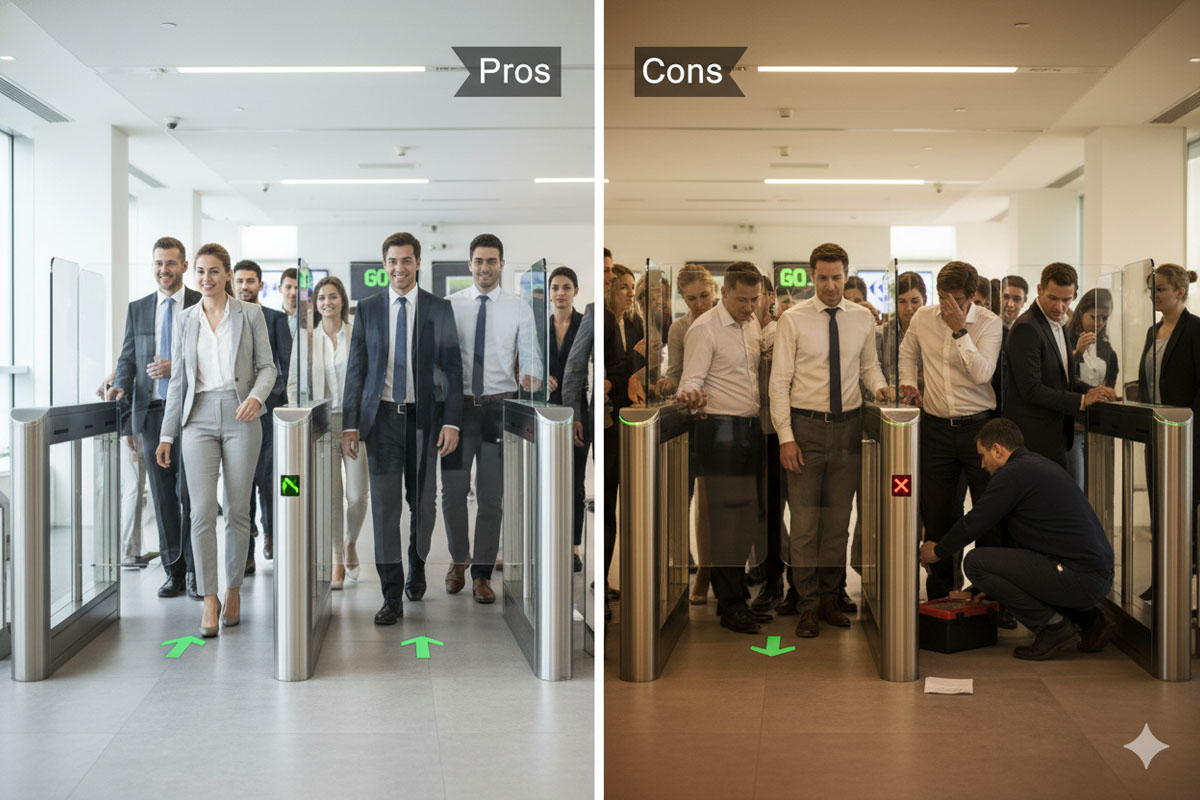
Flap Barrier Turnstiles: The Real Pros and Cons, and When They Beat Other Gates
“Flap barrier” is one of those product names that hides a set of trade-offs. Ask ten suppliers for the advantages and you will get the same marketing list. Ask them what goes wrong in year three and the conversation gets more useful. This article sets out both sides properly: what a flap barrier turnstile genuinely does better than a tripod, swing or full-height gate, where it underperforms, what typically fails, and how to decide whether it belongs at your entrance at all.
We build flap barrier turnstiles at our Dongguan factory — AIPADA has been manufacturing pedestrian access gates since 2014, with a 3,000 m² plant and a capacity of 3,000 units a month — so the failure modes below are the ones we see in service, not the ones in a brochure. Prices mentioned are China ex-works market references for budgeting.
What a Flap Barrier Actually Is
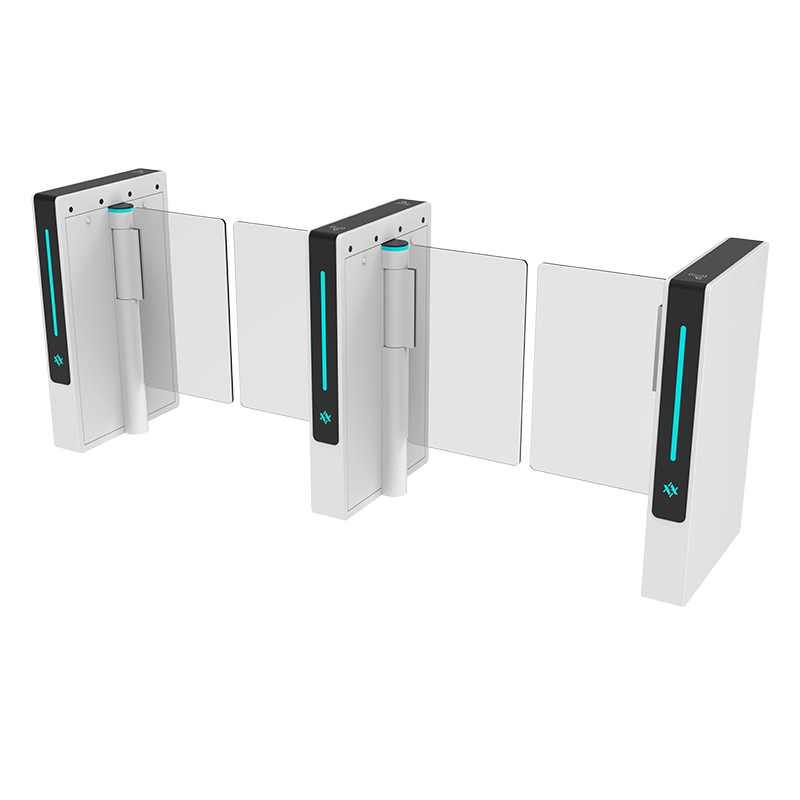
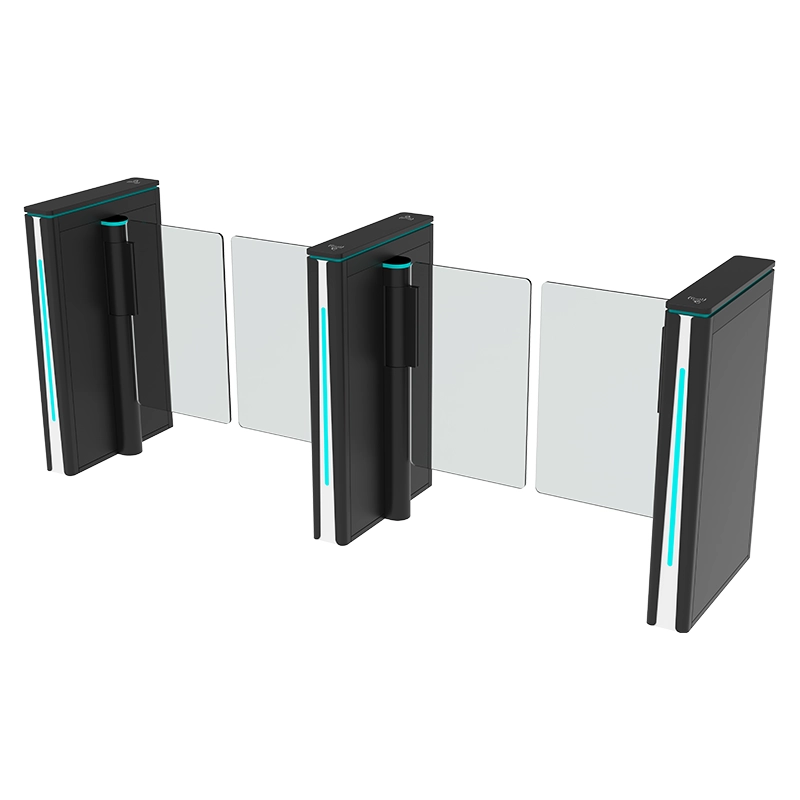
Two wings — acrylic, tempered glass, polycarbonate or stainless — mounted on the sides of a cabinet. Closed, they form a waist-height barrier across the lane. On an authorised credential the wings retract into the cabinet, the person passes, and the wings return. A sensor array across the lane decides whether the passage happened and whether it happened once.
That mechanism is the source of every advantage and every limitation that follows. The wings are light and fast because they do not have to stop a person. They are also light and fast because they cannot stop a person.
The Advantages, With the Numbers
Throughput
A modern flap barrier opens in roughly 0.4–0.6 seconds and sustains 30–40 passages per minute per lane. Compared with a tripod turnstile, which is limited by the physical rotation of the arms, that is a substantially higher ceiling — and it matters at any entrance where the peak fifteen minutes define the design, such as a shift change or a stadium gate.
Bidirectional traffic in one lane
Almost all flap barriers are bidirectional as standard: separate readers on each side, and the gate logic decides which way the person is going. A single lane can serve as entry in the morning and exit in the evening without any hardware change, which is difficult to achieve with most mechanical gates.
Accessibility and luggage
With a 900 mm clear lane a flap barrier passes a wheelchair, a roll-aboard suitcase, a cleaning trolley or a parent with a stroller. A standard tripod turnstile will not. If an accessible route has to pass through your gate line, that single requirement often decides the product before any other factor is considered.
Reader flexibility
Because the wings are motor-driven, the trigger can be almost anything: RFID card, NFC phone, QR or barcode, fingerprint, palm, face recognition, or a ticket validated by an external system. Swapping reader technology later is a module change, not a gate replacement. This is a real cost advantage over a mechanical gate whose credentialing is harder to change.
Visual and acoustic comfort
Wings sit at waist height so sight lines through a lobby stay open, and a good unit runs at ≤50 dB. For entrances that sit beside a reception desk or a hotel lobby, that combination is usually decisive against a full-height cage.
Anti-tailgating capability
Not inherent, but available: a multi-beam infrared array counts bodies crossing the lane rather than counting credential presentations. Two people on one card trigger an alarm and the gate refuses to reset for the next user. This is the feature that makes flap barriers viable in industrial and examination settings where simple card-and-open logic is not enough.
The Disadvantages, Stated Plainly
It is not a physical barrier
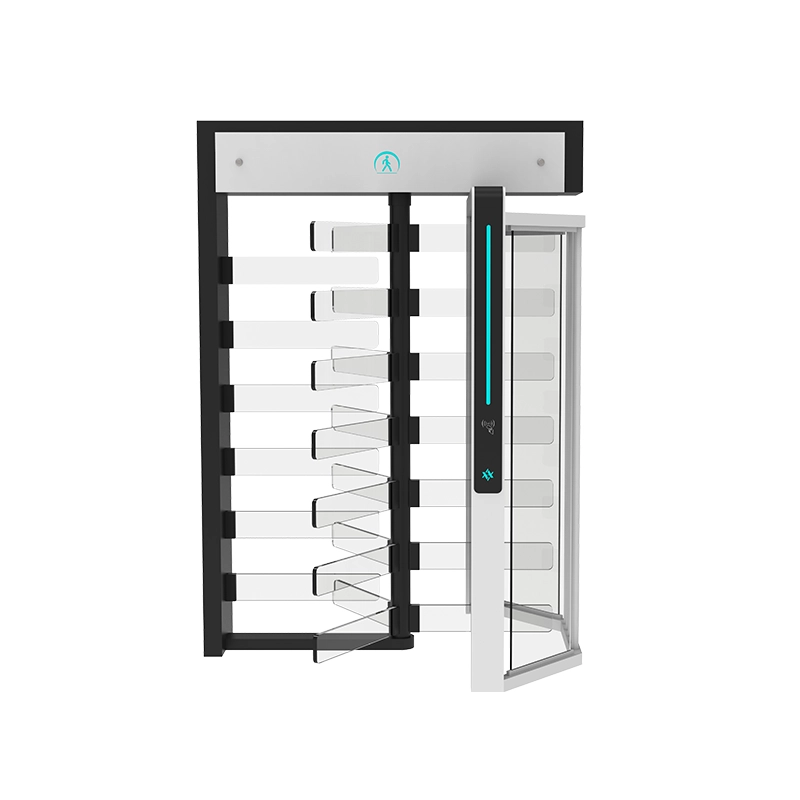
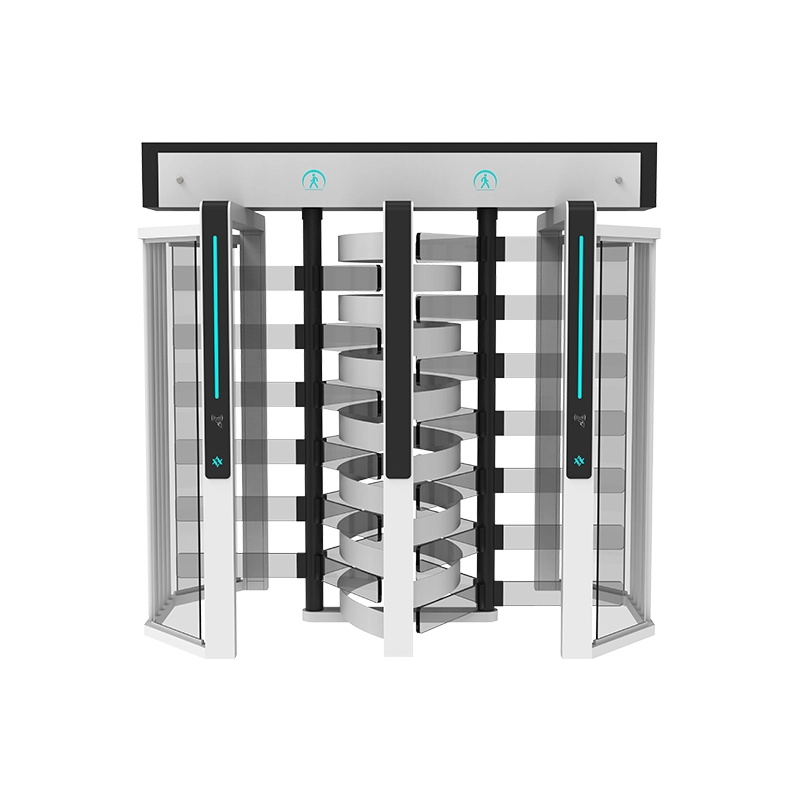
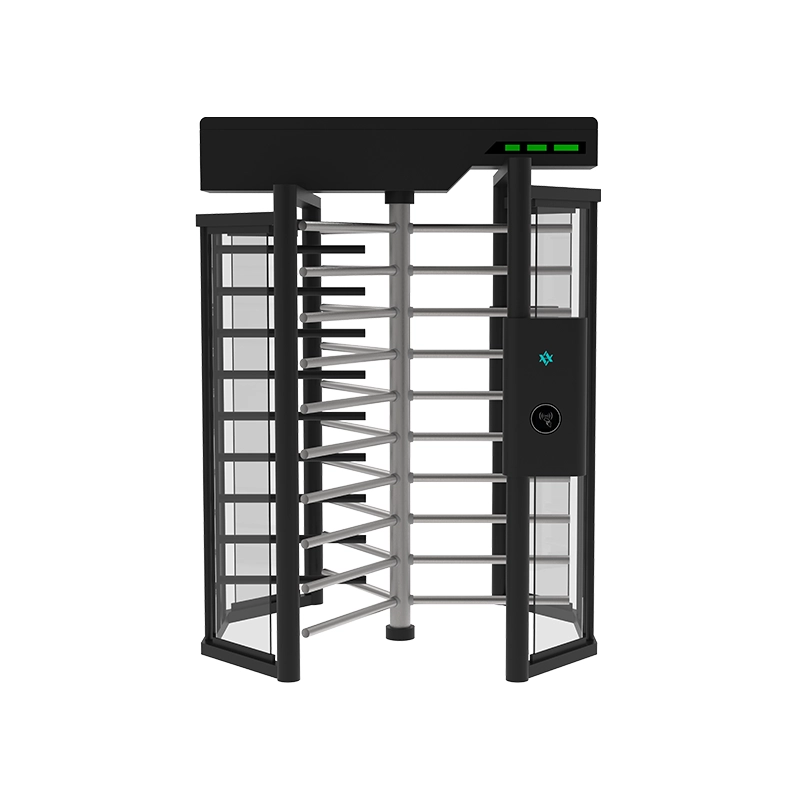
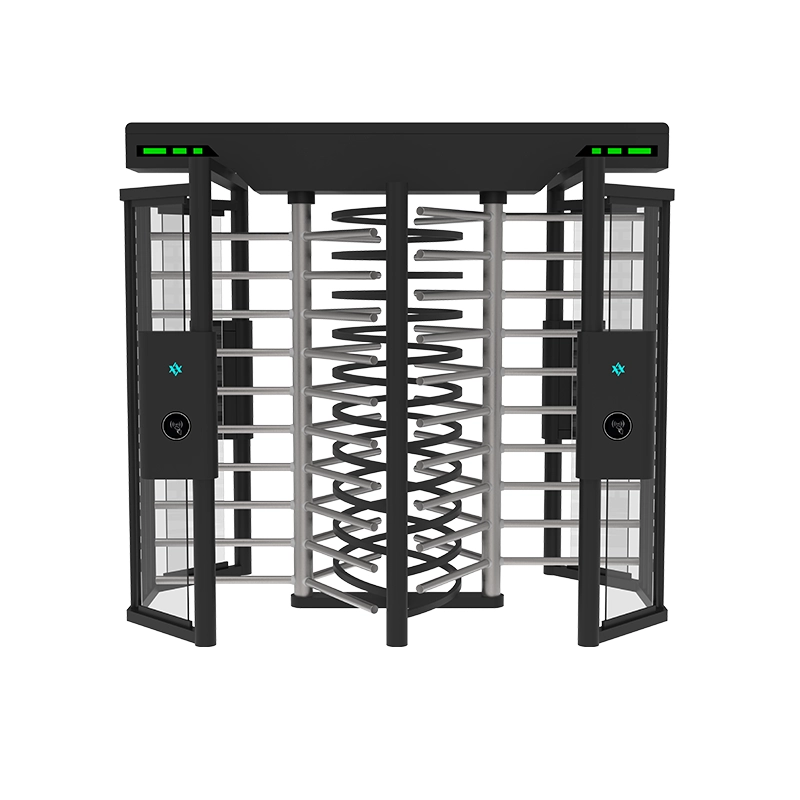
This is the one that matters. A waist-high flap barrier stops casual following, enforces one-person-per-credential and creates an audit trail. It does not stop someone prepared to step over or push through, and it does not contain a crowd. If your requirement is “nobody gets in without a valid credential, full stop”, the product is a full height turnstile, and our full height turnstile guide explains why. Choosing a flap barrier for a perimeter that must be vault-proof is the single most expensive specification error in this product family.
Wing damage is the main wear item
Acrylic and glass wings are the most frequently damaged component, usually from impact rather than from cycling — a trolley, a hurried pedestrian, a child leaning on the closed wing. Acrylic scratches and crazes; glass chips on the edge; polycarbonate absorbs impact but yellows over years in direct sunlight. On indoor installations the failure is rare. On a factory floor or a school corridor it is the first thing to plan for, which is why we ask about the operating environment before recommending a wing material.
Electronics and power dependence
A flap barrier needs power and a controller. A power failure, a failed power supply or a control board fault takes the lane out of service until it is fixed. Mechanical gates degrade more gracefully; electronic ones fail more abruptly. Battery backup and a documented fail-open or fail-locked strategy are not optional extras on a busy entrance — they are part of the design.
Higher purchase and service cost than a tripod
A flap barrier costs meaningfully more than a comparable tripod turnstile and needs its sensors, motor and controller maintained. For a low-traffic door where credentialing is the only requirement, a tripod is simply the better buy — the tripod turnstile guide covers that case.
Dirt and moisture sensitivity
The optics in the sensor array and the mechanism in the cabinet both dislike dust, grit and standing water. Outdoor or semi-outdoor installations need an IP-rated cabinet and a canopy; pool halls need materials chosen for chlorine. An indoor cabinet installed outdoors will usually keep working for a season and then start nuisance-tripping.
Weaker crowd containment than a swing gate
Where a lane must be opened wide for luggage, medical equipment or a service route, a swing gate with longer arms gives a wider clear opening with the same cabinet footprint. Our flap barrier vs swing turnstile comparison works through that trade-off.
How Flap Barriers Compare With the Alternatives
| Criteria | Flap barrier | Tripod turnstile | Swing turnstile | Full height turnstile |
|---|---|---|---|---|
| Throughput per lane | 30–40 /min | 20–30 /min | 30–40 /min | 15–25 /min |
| Physical containment | Low | Low–medium | Low | High |
| Wheelchair / luggage passable | Yes (900 mm) | No | Yes | Usually no |
| Power required | Yes | Optional | Yes | Optional |
| Reader flexibility | High | Medium | High | Medium |
| Typical purchase cost | Mid | Low | Mid–high | High |
| Best fit | High-traffic lobbies, ticketing, membership | Low-traffic staff doors | Wide accessible entrances | Perimeters that must be sealed |
The Failure Modes Nobody Advertises
Based on service experience across office, transit, retail and industrial installations, these are the faults that actually show up:
- False tailgate alarms. Almost always caused by sensor alignment drifting, or by reflective flooring and direct sunlight entering the lane. Re-alignment and, where necessary, a sun shield solve it.
- Wing not fully retracting. Debris or a worn drive bearing in the wing track. Usually a service item rather than a part replacement.
- Lane stuck open. Frequently a fail-open relay configuration combined with a controller fault. Worth knowing before it happens, because “stuck open” on a secure door and on a fire escape route require opposite fixes.
- Reader reads but the gate does not open. Nearly always an integration issue — wrong Wiegand format, a dry contact wired to the wrong terminal, or an access controller that is authorising in software but not asserting the output. See our flap barrier integration guide for the wiring sequence.
- Nuisance alarms in wet weather. Water in the lane base or ingress into the cabinet. A drainage detail and a cabinet seal, not a software fix.
- Wing material degradation. Polycarbonate yellowing, acrylic crazing, edge chipping on glass. Cosmetic until it is structural, then a wing replacement.
- Power supply aging. The least glamorous component and one of the more common causes of intermittent faults after year three. Ask any supplier what the PSU service interval is; a vague answer tells you something.
Most of this list is manageable with a scheduled service. Our maintenance guide sets out the inspection routine that applies to motorised gates of this family.
Site Conditions That Predict Problems
- Direct sun through glass onto the lane. Infrared sensor interference; specify a shading detail or a different sensor placement.
- Highly polished or mirrored floors. Reflections confuse the beams; a matte entrance mat in the lane is often the whole fix.
- Heavy trolley or cart traffic. Plan for impact-resistant wing material or bump bars, and expect higher wing maintenance.
- Dust, grit or metal swarf. Specify sealed bearings and a maintenance interval short enough to matter.
- Standing water or wash-down. Raise the cabinet base or specify an IP-rated unit; do not assume the mechanism tolerates it.
- Voltage instability. Shared with welding equipment or large motors on the same distribution board, a barrier will misbehave. A small UPS is cheap insurance.
Decision Guide: Flap Barrier, or Something Else?
| If your requirement is… | Choose |
|---|---|
| High traffic, indoor, aesthetics matter, credentials change over time | Flap barrier |
| Accessible lane must pass a wheelchair or luggage | Flap barrier at 900 mm, or a swing turnstile |
| Ticket or membership validation at speed | Flap barrier with an integrated scanner |
| One-person-per-credential enforcement with an audit trail | Flap barrier with counting sensors |
| Nobody gets in without a credential, by any means | Full height turnstile |
| Low-traffic staff door on a tight budget | Tripod turnstile |
| Very high throughput with wide, open lanes | Speed gate |
| Highest throughput with a premium lobby finish | Sliding turnstile or speed gate |
What Drives the Price
Two suppliers can quote very different numbers for what looks like the same flap barrier. The differences are almost always in these five items:
- Cabinet gauge and finish. 304 stainless at 1.2 mm versus 1.5 mm, brushed versus mirror, painted versus full stainless. This is the largest single variable.
- Motor and mechanism class. Duty rating determines whether the unit is built for an office door or a transit concourse.
- Sensor count. A simple presence sensor is not the same product as a multi-beam counting array.
- Reader and controller. Supplied by the gate manufacturer or by the client’s access control vendor — a significant part of the total project cost either way.
- Compliance and documentation. CE marking, test reports and a real warranty have a cost. A quote that is far below the market usually reflects a missing item on this list rather than a cheaper factory.
Specification Sheet: What to Write Down Before You Ask for a Quote
Nine times out of ten, two suppliers quote very different numbers for the same project because the enquiry was a sentence rather than a specification. Write these down and the comparison becomes meaningful:
| Item | What to state | Why it changes the price |
|---|---|---|
| Lane count and direction | Entry / exit / bidirectional per lane | Bidirectional lanes carry two readers and more logic |
| Lane width | 600 mm standard, 900 mm accessible | Wider lanes need longer wings and a wider cabinet |
| Credential types | Card, QR, fingerprint, face, ticket — and what might be added later | Reader and controller are a significant part of total cost |
| Cabinet finish | 304 or 316 stainless; brushed, mirror, painted | The single largest material variable |
| Wing material | Acrylic, tempered glass, polycarbonate, stainless | Impact resistance versus appearance versus cost |
| Duty class | Cycles per day and peak throughput | Determines motor, drive and mechanism class |
| Environment | Indoor; outdoor with or without canopy; wet or dusty | Drives sealing, IP rating and materials |
| Fail mode | Fail-open or fail-locked, and in which direction | A wiring decision that cannot be changed by software later |
| Integration | Access control platform, signal type and cable distance | Determines whether a controller module is needed |
| Documentation | CE certificate, manual, wiring diagram, warranty terms | Cheap quotes frequently omit these |
An enquiry that answers all ten lines can be quoted in a day. An enquiry that says “we need turnstiles for our office” will produce a range of guesses that cannot be compared.
Two Installations, Two Different Answers
Abstract comparisons are hard to act on, so here are two projects that look similar and end up with different hardware.
Case A — 60-person software office, one entrance. Peak arrival is about 40 people in twenty minutes. The client wants a sign-in record and does not want the lobby to look like an airport. The answer is one bidirectional flap barrier lane at 900 mm, serving as both the accessible route and the main door, with card readers and a QR module for visitors. Two lanes would be over-specified; a full height turnstile would be wrong on appearance, accessibility and cost. Ongoing service is an annual visit.
Case B — 700-person manufacturing shift, perimeter entrance. Peak arrival is 700 people in twenty minutes, outdoors, next to the plant gate. The client’s concern is unauthorised entry onto the site. The answer is four flap barrier lanes indoors at the personnel door and two full height turnstiles at the perimeter, with the perimeter lanes sized so that a single fault does not close the site. Doors are the vulnerable element in Case B, not the gates — which is why the specification includes an interlock on the perimeter and a documented procedure for shift change.
The lesson is not “flap barriers for offices and full height for factories”. It is that throughput, environment, accessibility and the actual threat determine the answer, and they are all knowable before a single quotation is issued.
Frequently Asked Questions
Are flap barriers suitable for outdoor use?
Only with an outdoor specification. The mechanism needs an IP-rated, sealed cabinet and a canopy or shelter, and the finish needs to survive the local climate. Indoor units installed outside are the most common cause of premature failure we are asked to diagnose.
How long do the wings last?
On an indoor office installation, a decade is not unusual. In a school corridor or on a factory floor with trolley traffic, plan for potential wing replacement in a fraction of that time — and choose polycarbonate or solid stainless rather than glass if impact is likely.
Can I add face recognition or QR scanning later?
Usually yes, which is one of the practical advantages of a motorised gate. The barrier consumes a trigger signal; changing the device that produces that signal is a reader change and a configuration update rather than a new gate. Confirm the controller’s input options when you buy — ask which formats it accepts (dry contact, Wiegand, RS-485, network).
What is a realistic service interval?
For a normal commercial entrance, an annual inspection of the mechanism, wings, sensors and power supply, plus cleaning of the sensor optics. For heavy-duty environments, quarterly. The dominant variable is cycles per day, not calendar time.
Do flap barriers count people?
They can, and increasingly do. Counting accuracy depends on the sensor array and the lane geometry. The number is reliable enough for occupancy management and for gate enforcement; it is not a substitute for a dedicated people-counting system where the count is a business metric.
Why is one supplier 40% cheaper?
In our experience it is almost always one of: thinner stainless, a lighter-duty motor, a single sensor rather than an array, no CE documentation, or a warranty that is difficult to enforce internationally. None of those is visible in a product photograph, which is why the specification sheet matters more than the catalogue image.
How many lanes should the average office project install?
Size against the peak fifteen minutes rather than headcount, then add one spare. As a rough starting point, a 300-person office arriving within half an hour needs two entry lanes plus an accessible lane in the same bank; a 900-person tower needs three to four. The most reliable way to get this right is to count the arrival pattern for a week — the client’s facilities team usually already knows it.
Is it worth buying a heavier duty model than the traffic requires?
Usually not, with one exception. Paying for a transit-grade mechanism on an office door buys cycles that will never be used. The exception is the reader and control board: a slightly better reader shortens every passage and reduces the daily friction, which users notice more than the mechanism class does.
What should the service contract actually cover?
Wing alignment and drive inspection, sensor cleaning and re-alignment, mechanism lubrication, power supply measurement under load, a release-pulse check at each lane, and a fire-release test. Insist on a written record of the settings after each visit; without it, the next technician has to rediscover the configuration.
How do I choose between acrylic, glass and polycarbonate wings?
Acrylic is light, inexpensive and clear, and it scratches. Tempered glass looks best in a premium lobby and chips on the edge if struck. Polycarbonate takes impact best and yellows over years in direct sunlight. In a lobby, glass or acrylic; where trolleys, luggage or children are present, polycarbonate; outdoors, expect to replace any of them eventually.
Buying Flap Barriers
AIPADA has manufactured turnstiles and pedestrian access gates since 2014, in a 3,000 m² plant in Dongguan, China, with an output capacity of 3,000 units per month. We supply engineering contractors and distributors in Europe, the Middle East, Southeast Asia and South America, and every flap barrier ships with CE certification, a two-year warranty, MOQ of one unit and a standard lead time of 7–15 days. Browse the range in the flap barrier turnstile catalogue or read the flap barrier technical guide.
Prices are China ex-works market references for budgeting. Request a quotation for a firm figure based on your lane count, finish and reader configuration.