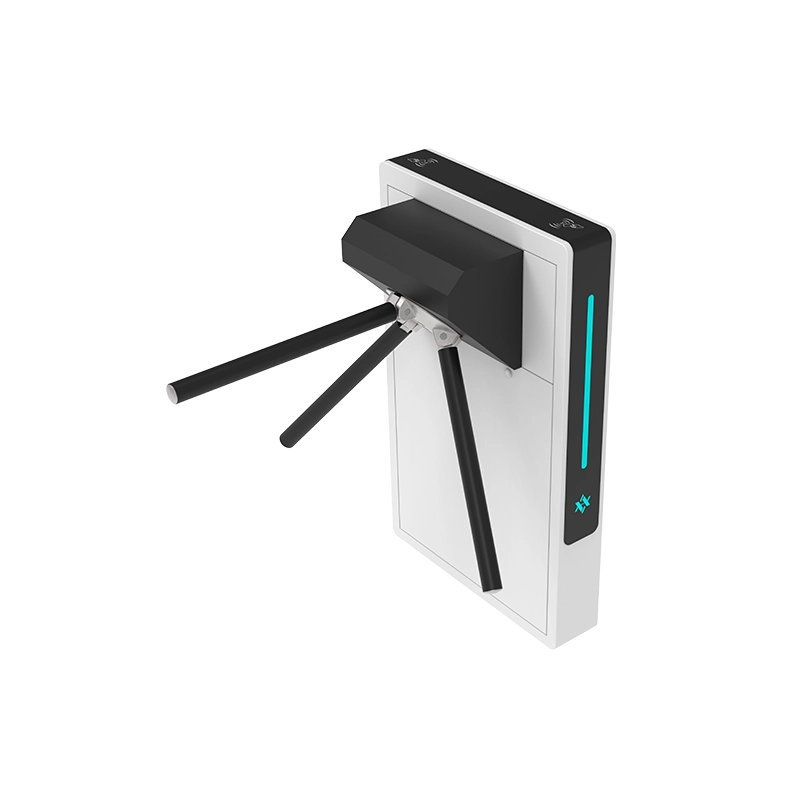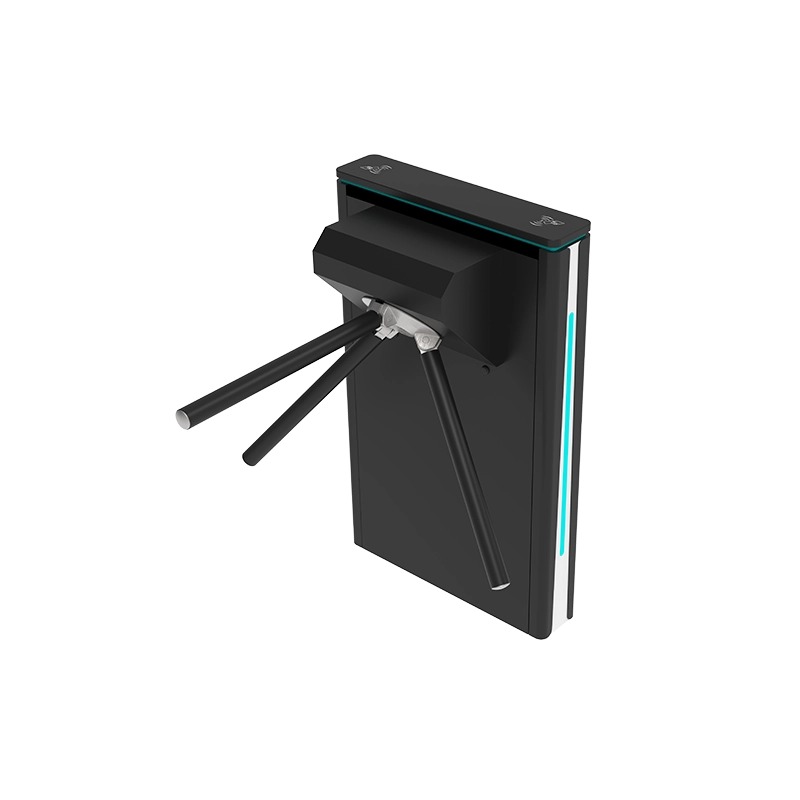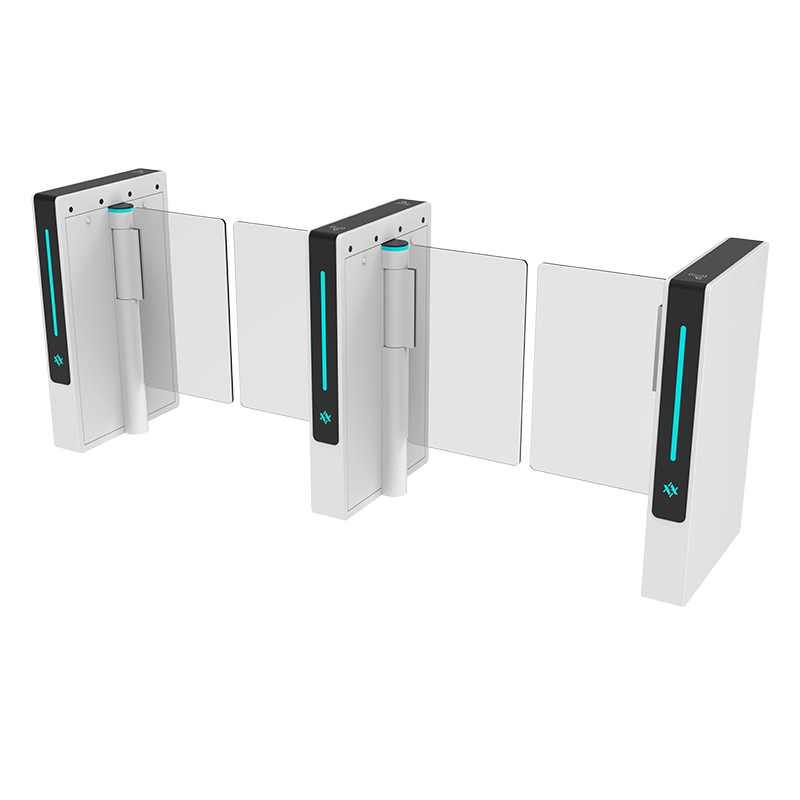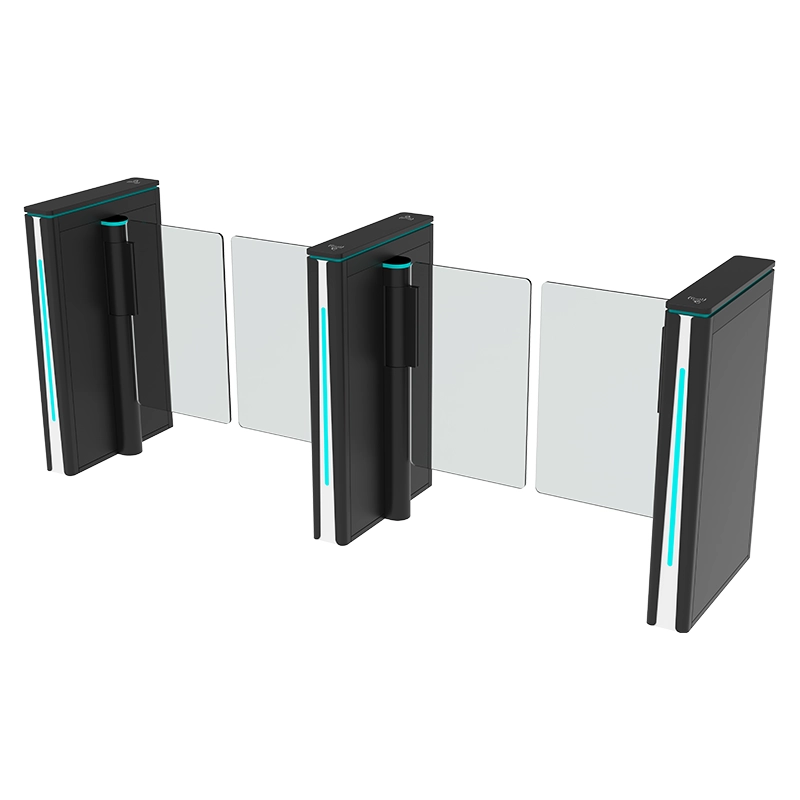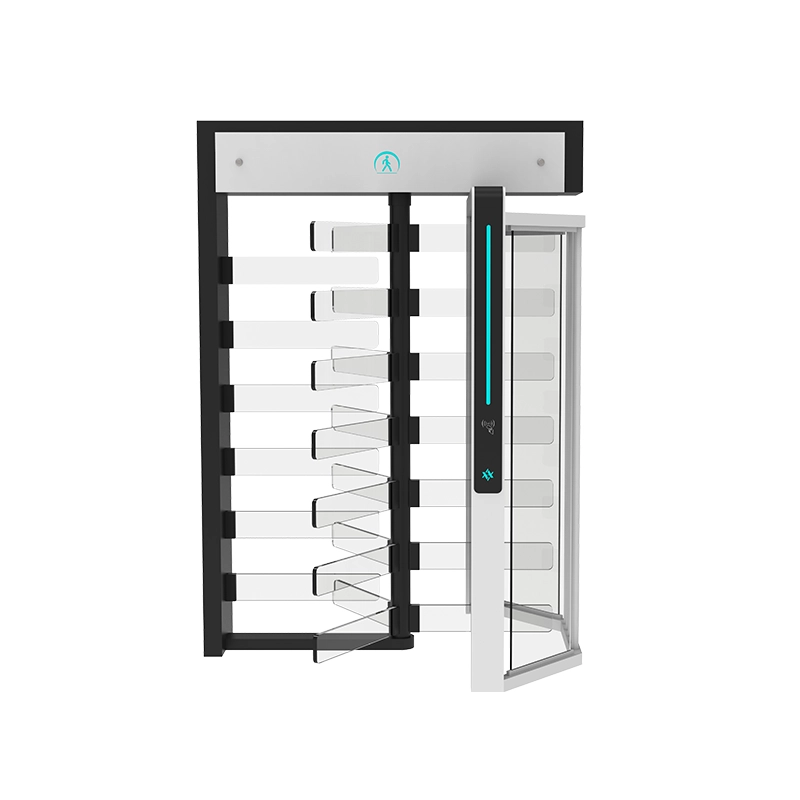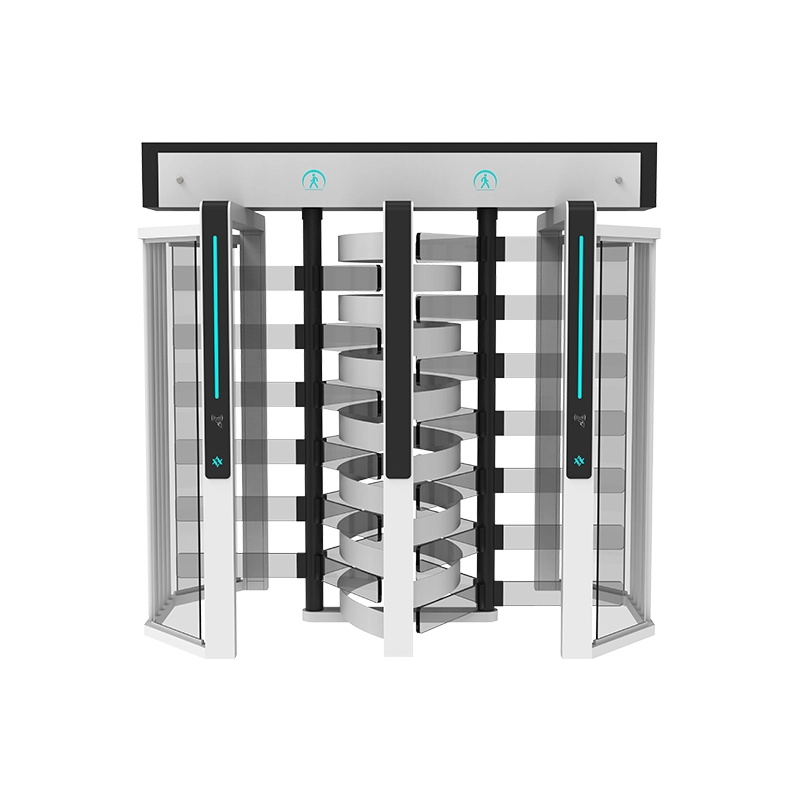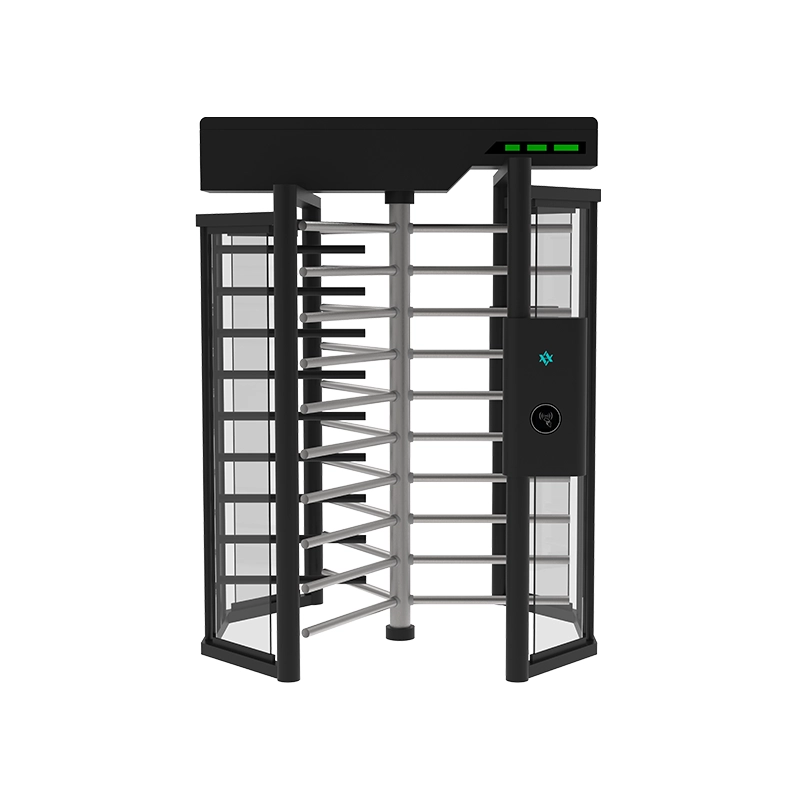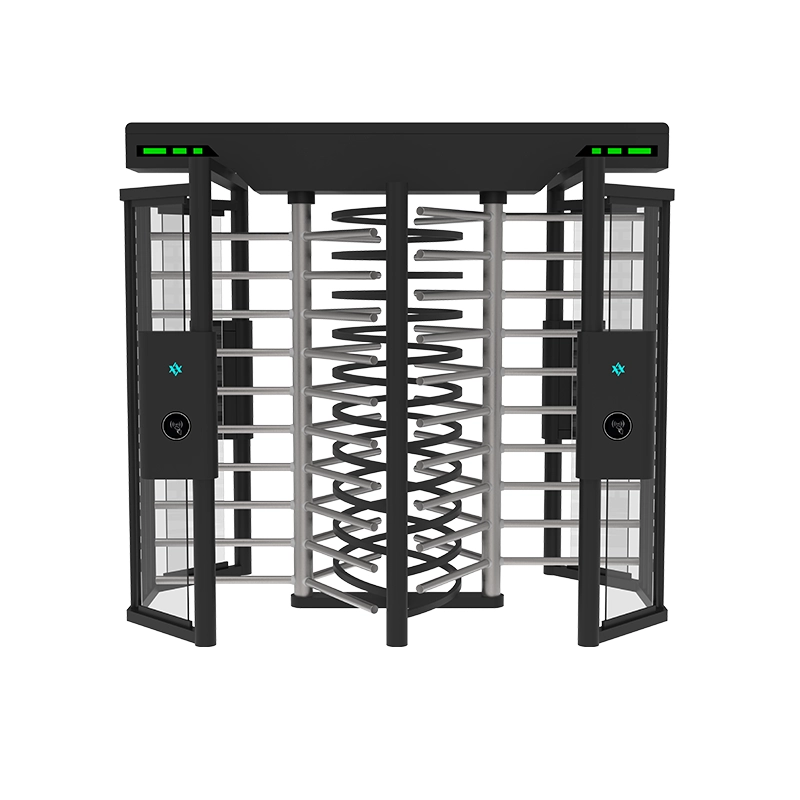

Security speed gates are motor-driven pedestrian lanes that combine three things most entrance products only deliver in part: a physical barrier that stops an unauthorized body, sensor logic that watches the whole passage rather than just the moment of authorization, and an audit trail that records who went through, when, and whether anyone went with them. A decorative glass lane and a real security lane can look identical in a lobby photograph, then behave very differently at 8:55 on a Monday morning.
This guide is for the people who sign off on an entrance: security managers, facility engineers, and integrators. It covers what “security” means in a speed gate, how anti-tailgating detection works, where credentials fail, and how lanes integrate with CCTV and event logging.
If you are still comparing product families, the working principle and types of turnstiles explains how tripod, swing, and full-height barriers differ mechanically. If you already need a speed gate, the AIPADA speed gate turnstile range shows cabinet structures and lane widths.

What “Security” Actually Means in a Speed Gate
Layer 1: Physical Barrier
The physical layer stops a person who has no credential and no intention of getting one. It includes panel material, panel height, cabinet depth, and the mechanical strength of the arm and drive. A standard panel stands roughly 900 mm to 1,700 mm. A tall glass wing is a serious deterrent to a casual intruder, though not to a determined person with a tool.
Layer 2: Passage Detection
Detection distinguishes a security speed gate from a motorized door. Sensors watch the entire crossing, not just the credential read, and generate the tailgating alarm, wrong-way alarm, anti-pinch response, and the timeout that cancels a credential nobody used. Quality depends on the number and arrangement of infrared beam pairs, any height or weight sensing, controller logic, and lane width.
Layer 3: Audit Trail and Event Logging
The third layer is the record. Every authorization, passage, alarm, and forced-entry attempt should produce a timestamped event that reaches a system somebody reviews. Without it, the gate detects a tailgating event and nobody can reconstruct what happened. With it, a manager can pull the event, match it to CCTV, and identify the person who followed in. See the speed gate access control systems guide.
| Layer | What it protects against | Key specification | Typical failure mode |
|---|---|---|---|
| Physical barrier | Unauthorized body, casual intrusion, reverse passage | Panel height, material, drive torque, direction lock | Panel too low for the risk; lane left bidirectional |
| Passage detection | Tailgating, wrong-way entry, obstruction, credential reuse | IR beam pair count, height/weight/vision sensors, controller logic | Beam pairs reduced to cut cost; alarm thresholds left at default |
| Audit trail | Undetected incidents, unverifiable disputes, no pattern analysis | Event logging, timestamps, alarm output to VMS, retention period | No integration; alarms sound locally and are never recorded |
Anti-Tailgating Technology: How the Sensors Actually Work
Tailgating is when an unauthorized person follows an authorized user through the same lane on the same valid credential. It is the most common defeat of pedestrian access control, and the main reason detection matters more than the reader.
Infrared Beam Pair Counting
The standard method places several infrared transmitter and receiver pairs across the lane. Each reports an interruption, and the controller reads the sequence and duration of interruptions, not just whether one beam broke.
The logic distinguishes normal from abnormal by count. One credential, one crossing: a short, orderly sequence that clears and returns to rest. Two people moving close together: more interruptions, spaced in a pattern that does not match a single body. That mismatch triggers the alarm. More beam pairs mean a finer pattern the controller can resolve and fewer ambiguous events.
Beam pairs also drive wrong-way detection and anti-pinch protection. While the panels move, the controller watches the protected zone. If a beam reports an obstruction, the controller can stop, delay, or reverse the closing motion, protecting wheelchairs, luggage, and people who follow closely.
Height Sensing and Weight Detection
Beam counting struggles with one case: an adult and a small child entering together read as an ambiguous body profile, and a person bending or crouching distorts the pattern. Height sensors add a vertical dimension; weight platforms add mass. Both give the controller an independent cross-check, at added cost, and are worth it where the threat includes deliberate tailgating.
Vision-Based Detection
Camera-based monitoring adds a third signal class. Instead of counting beam interruptions, a vision system tracks the number of distinct people in the passage and flags a second person entering on a single authorization, attaching a still frame to the alarm. It is not a replacement for beam sensors: performance depends on lighting, camera position, and processing power, and it needs its own privacy policy. Deployed well, it turns a generic alarm into an actionable event with an image.
Controller Logic and Thresholds
Hardware generates signals; the controller decides what they mean. Passage timeout, alarm delay, alarm reset, and sensitivity thresholds are programmable, and two sites with identical hardware can have very different false-alarm and detection rates from these settings alone. Commissioning should include a documented test sequence: single pass, tailgate attempt, wrong-way attempt, and an abandoned credential.
Credential Security: Where Attacks Actually Land
Detection protects the passage. Credentials protect the authorization. Both can be defeated, and they fail differently.
Card Cloning
Low-frequency 125 kHz proximity cards are trivially readable with equipment that fits in a pocket. If entrance security relies entirely on that credential class, the lane is strong against tailgating and wide open to cloning. The upgrade path is higher-frequency cards with mutual authentication and encrypted challenge-response, or mobile credentials where the phone’s secure element holds the key.
Face Anti-Spoofing
Facial recognition terminals vary enormously in presentation-attack resistance. A basic 2D system can be fooled by a printed photo or a phone screen. Liveness detection requires the subject to be physically present through depth sensing, infrared reflectance, or a challenge requiring micro-movement. For a data center lobby or restricted floor, anti-spoofing is a specification line item. Confirm which attack types the terminal is rated against at the entrance lighting.
QR Code Rotation
Static QR codes emailed to visitors are shareable screenshots that stay valid until expiry. Rotating QR codes regenerate on a short cycle, are tied to a specific time window and often a specific device, and combine with an audit record linking the code to a named visitor and host. That combination is what makes a visitor lane meaningful rather than decorative.
Credential and Lane Must Match
The most common design error is pairing a strong credential with a weak lane, or the reverse. A biometric terminal on a lane with two beam pairs and no tailgating logic verifies the first person and ignores the second. A high-security lane with clonable cards means detection is watching people who should never have been authorized. The access control hardware range shows how readers are specified alongside lanes.
| Credential | Clone / spoof resistance | Best fit | Watch out for |
|---|---|---|---|
| 125 kHz proximity card | Low | Low-risk internal areas | Pocket readers clone these easily |
| 13.56 MHz smart card, mutual auth | Moderate to high | Corporate offices, most entrances | Key management discipline required |
| Mobile credential (secure element) | High | Workforces with managed phones | Enrollment and revocation process |
| Static QR code | Very low | Short visits with staffed reception | Shareable as a screenshot |
| Rotating QR code | Moderate | Visitor and contractor management | Needs live issuance system |
| 2D facial recognition | Low | Convenience-focused lanes | Photo and screen attacks |
| Facial recognition with liveness | High | Restricted lobbies, data centers | Lighting and enrollment quality |

Integration with CCTV and Event Logging
Alarm Outputs
A lane that alarms locally and records nothing is a noise generator. Lanes expose alarm outputs for tailgating, wrong-way passage, forced entry, prolonged obstruction, and unauthorized attempt. These can drive a local alarm, a relay into a security panel, or a software event in the access control platform. In a staffed lobby, both local and remote is usually correct: the lane warns the person, the platform warns the operator.
Event Logging
Each lane should log, at minimum: credential presented, authorization granted or denied, passage completed or abandoned, and every alarm with a timestamp, kept for a retention period matching building policy and exportable for investigation. Confirm whether logs live in the access control software or a VMS.
Pairing With Video
The most useful integration links the lane event to the camera covering that lane, so a tailgating alarm takes the operator straight to the footage. In a multi-lane entrance, plan camera coverage per lane with an unobstructed view of the passage and reader. Beyond live response, logs enable pattern analysis: which lane alarms most, at what times, and whether an entrance has a persistent tailgating problem, which drives decisions about staffing and credential type.
Fail-Safe vs Fail-Secure on Power Loss and Fire Alarm
This is a life-safety decision, and it must be explicit in the specification before production. Getting it wrong is not a security weakness but a hazard.
Fail-Safe (Fail-Open)
On power loss or emergency input, the barriers release and the lane opens. This is the normal requirement for egress paths and any lane on an evacuation route. It protects people at the cost of leaving the entrance open during an outage.
Fail-Secure (Fail-Locked)
On power loss, barriers remain closed and the lane stays locked. This protects the asset at the cost of trapping people if the lane is on an egress route. Fail-secure is appropriate only where the lane is not on an evacuation path, egress is provided by separate doors, and asset-loss risk exceeds blocked-egress risk. It also requires battery backup for readers and controllers.
Fire Alarm Interface and Battery Backup
Where a lane sits on an egress route, the fire alarm system should command the barriers open regardless of the fail-safe/fail-secure setting. This is a supervised interface coordinated with the building fire system, and it must be tested, not assumed. Battery backup keeps controllers and readers running through short outages, preserving the audit trail and letting authorized users pass. Decide whether the lane opens, locks, or maintains normal operation on backup, and confirm runtime.
| Condition | Fail-safe behavior | Fail-secure behavior | When each is correct |
|---|---|---|---|
| Mains power loss | Barriers release, lane open | Barriers stay closed, lane locked | Fail-safe on egress routes; fail-secure on non-egress asset lanes |
| Fire alarm | Barriers open on alarm signal | Barriers open if on an egress route | Fire interface required wherever the lane is on an egress route |
| Emergency manual input | Lane opens immediately | Opens only if configured for egress | Confirm against building safety plan |
| Battery backup active | Normal operation until depleted | Locked but readers and logs still powered | Fail-secure deployments need reader backup to avoid lockouts |
Security Level Tiers: Basic, Standard, High
Not every entrance needs the same configuration, and over-specifying wastes budget on lanes operated identically to cheaper ones. The useful question is not “what is the most secure gate” but “what risk does this entrance face, and who supervises it.” Three tiers cover most projects, driven by threat, volume, staffing, and alarm response time.
| Element | Basic | Standard | High |
|---|---|---|---|
| Typical use case | Staffed office lobby, membership facility, low-risk zone | Corporate HQ, business park multi-lane entrance, research office | Data center lobby, government building, restricted floor |
| Panel height | Standard, approx. 900–1,200 mm | Mid to tall, approx. 1,400–1,600 mm | Tall, approx. 1,700 mm and above |
| Sensor array | Basic beams, anti-pinch and wrong-way | Extended beam array with tailgating alarm | Extended beams plus height or vision cross-check |
| Credential | RFID card or static visitor QR code | Smart card with mutual auth, mobile, rotating QR | Liveness-checked face or palm vein |
| Supervision and alarms | Reception in sight; local alarm | Security desk; local plus logged software event | Staffed checkpoint; VMS integration and video pairing |
| Fail behavior | Fail-safe on egress routes | Fail-safe with defined fire interface | Documented fail mode, fire interface, reader battery backup |
| Indicative lane price (China ex-works) | From approx. USD $1,000 per lane | Mid range, quote-dependent | Up to approx. USD $3,500 per lane |
These are indicative China ex-works reference figures for planning only. Actual pricing depends on panel height and material, sensor configuration, drive type, reader integration, lane width, finishes, and order quantity, and requires a formal quotation. For how these numbers are built up, see the speed gate manufacturer guide.
Security Speed Gate vs Traditional Turnstile
Speed gates win in high-traffic, supervised, indoor entrances where throughput and appearance matter, and lose where the requirement is a hard physical barrier at an unattended or outdoor perimeter.
Where Speed Gates Win
Throughput is the clearest advantage. A swing barrier opening is fast, lanes are wide enough for passage with a bag, and authorized users clear the lane without breaking stride. In an office tower with a sharp 8:30 to 9:00 arrival peak, that speed prevents a queue from forming down the street. With sensor-based detection and reporting, the speed gate gives control without the friction of mechanical rotation.
Where Speed Gates Lose
A speed gate’s physical restriction is moderate. The panels are an obstacle, not a wall. At an outdoor perimeter, an unattended site, or a location where a determined person will simply push or climb, a full-height turnstile is the correct product: a much stronger barrier built for unsupervised, weather-exposed locations. Speed gates also lose where there is no supervision or alarm response, since detection is only useful if someone acts on it.
| Requirement | Security speed gate | Tripod turnstile | Full-height turnstile |
|---|---|---|---|
| Modern indoor lobby | Excellent | Acceptable | Usually unsuitable |
| Fast authorized passage | Excellent | Moderate | Lower |
| Sensor-based monitoring | Strong, built into lane | Depends on added sensors | Mainly physical restriction |
| Strong physical restriction | Moderate | Moderate | High |
| Accessible wide lane | Available within layout | Separate gate normally required | Dedicated solution required |
| Unattended outdoor perimeter | Not recommended | Limited | Best fit |
Deployment Case Patterns
The same product family behaves differently across building types because the threat, traffic pattern, and supervision model differ. These four patterns cover most commercial deployments.
Corporate Headquarters
The dominant concern is tailgating by employees who know each other, plus unauthorized visitor entry. The typical design is a bank of lanes at the main lobby with one wider accessible lane, smart-card or mobile credentials for staff, rotating QR codes for visitors issued at a staffed desk, and a tailgating alarm reaching the desk and the access control platform. Peak flow drives lane count.
Data Center Lobby
Here the threat model assumes deliberate defeat. The typical design uses tall panels to limit climb-over, extended beam arrays plus height or vision cross-check, and liveness-checked biometrics rather than clonable cards. The lane may sit on a non-egress path where fail-secure is appropriate, with separate egress doors and a documented fire interface.
Stadium or Arena
The problem is extreme burst volume and moving people fast without a security collapse. Lanes are wide, sensor coverage is planned for dense spacing, and the credential is usually access media: rotating QR codes on tickets or mobile credentials. The critical points are peak throughput per lane, clear direction indicators, and a rejected-credential procedure.
Government Building
Requirements are typically driven by a formal security specification dictating credential class, logging retention, fail behavior, and alarm reporting. Expect a staffed checkpoint in addition to the lane, extended log retention, and a tested fire interface. The lane is one component in a layered process that includes screening and visitor escorting.
Specification Checklist
A supplier cannot recommend a configuration accurately without these items, and an incomplete brief is the most common cause of an unsuitable installation.
- Entrance drawing with installation dimensions and clear cabinet space
- Required number of entry, exit, and bidirectional lanes
- Expected pedestrian volume at peak, not just average daily traffic
- Standard and accessible lane width requirements
- Barrier panel height, material, and required lobby finish
- Credential types: RFID, smart card, mobile, QR, facial, or palm
- Existing access control software, reader interfaces, and communication protocol
- Required alarm events and routing (local, software, or both), and who responds
- CCTV integration, event-to-video pairing, log retention period, and export format
- Fail-safe or fail-secure decision, fire alarm interface type, and battery backup requirement
- Operating environment (indoor, damp, coastal, temperature range) and peak throughput target per lane
- Installation, commissioning, and on-site test procedure requirements
AIPADA manufactures speed gates and turnstiles at its Dongguan factory, holding CE certification ZR0119400918C, a CMA and CNAS test report UCT1648D35, design patent ZL 2021 3 0788509.8, and four software copyrights. Lead time is 7 to 15 days, MOQ is 1 unit, payment is T/T with 30% deposit, and the warranty is 2 years with lifetime support. Exports go to Europe (40%), the Middle East (25%), Southeast Asia (20%), and South America (15%).
Frequently Asked Questions
What is the difference between a speed gate and a security speed gate?
Physically they are the same product family. “Security speed gate” describes the configuration rather than the hardware: enough infrared beam pairs to resolve passage patterns, controller logic that generates tailgating and wrong-way alarms, logging that produces an audit trail, and integration with a credential system and monitoring platform. A lane without those elements is an access-controlled door, not a security lane.
Can a security speed gate actually prevent tailgating?
It can detect tailgating reliably when the sensor array is properly specified and the alarm is acted on, but it cannot physically prevent a determined person from following closely. Detection plus a supervised response is the realistic claim. What matters most is beam pair count, lane width, controller thresholds, and whether someone responds.
How many infrared beam pairs should a security lane have?
There is no single correct number, but a lane intended for tailgating detection needs a materially denser array than a basic anti-pinch lane. Fewer beam pairs mean a coarser pattern and more ambiguous events. Ask the supplier to state the beam pair count and what scenario the lane was tested against, rather than accepting “infrared sensors” as a specification.
Should the lane fail open or fail closed on power loss?
If the lane is on an egress route, it should fail open, and the fire alarm system should be able to command it open. If it is not on an egress path and protects a high-value asset, fail-secure may be appropriate, provided separate egress exists and readers have battery backup. Decide this with the building safety plan, not the gate supplier alone.
Can a speed gate connect to our existing access control and CCTV systems?
Most commercial lanes accept authorization signals from third-party readers and terminals and provide alarm outputs consumed by access control software or a VMS. The constraints are the communication interface, reader mounting, wiring distance, and whether the software can ingest the lane’s events. Confirm these before production.
How much do security speed gates cost?
As a China ex-works reference, expect roughly USD $1,000 to $3,500 per lane depending on panel height and material, sensor configuration, drive type, credential integration, lane width, and finish. Exact pricing requires a quotation based on the checklist above, and the tier a project selects usually matters more to total cost than any single option.
Plan the Entrance Around the Risk
The three layers of a security speed gate — physical barrier, passage detection, and audit trail — must be specified together, and fail behavior decided before production. Credential choice and lane configuration must match, and the alarm has to reach someone who can respond. When those pieces line up, a speed gate delivers fast, controlled, documented passage. When they do not, it delivers an expensive lobby feature.
Start from the threat at the entrance, the peak volume it must handle, the supervision available, and the evacuation requirement. That combination determines the tier, and the tier determines the configuration. Send AIPADA your entrance dimensions, lane quantity, pedestrian volume, and credential method, and the team can recommend a layout and configuration.
To review cabinet structures and lane options, see the speed gate turnstile product range or request a configuration for your entrance.