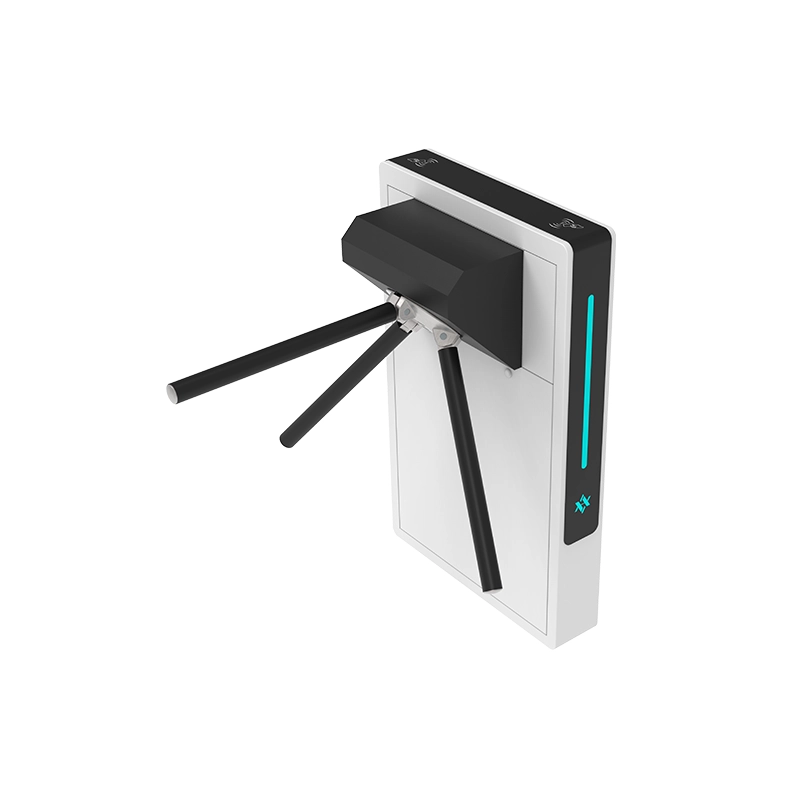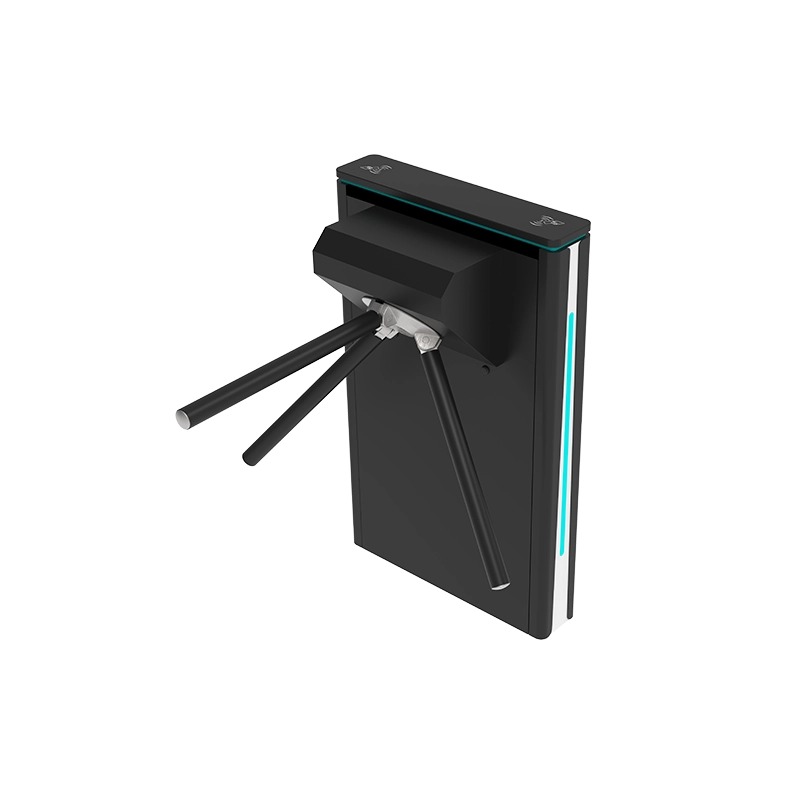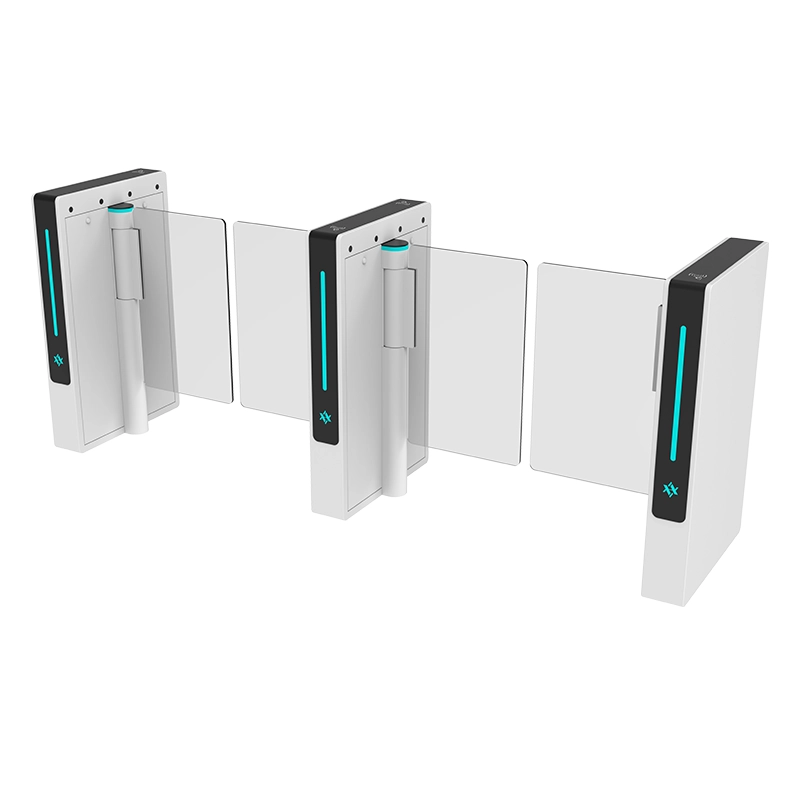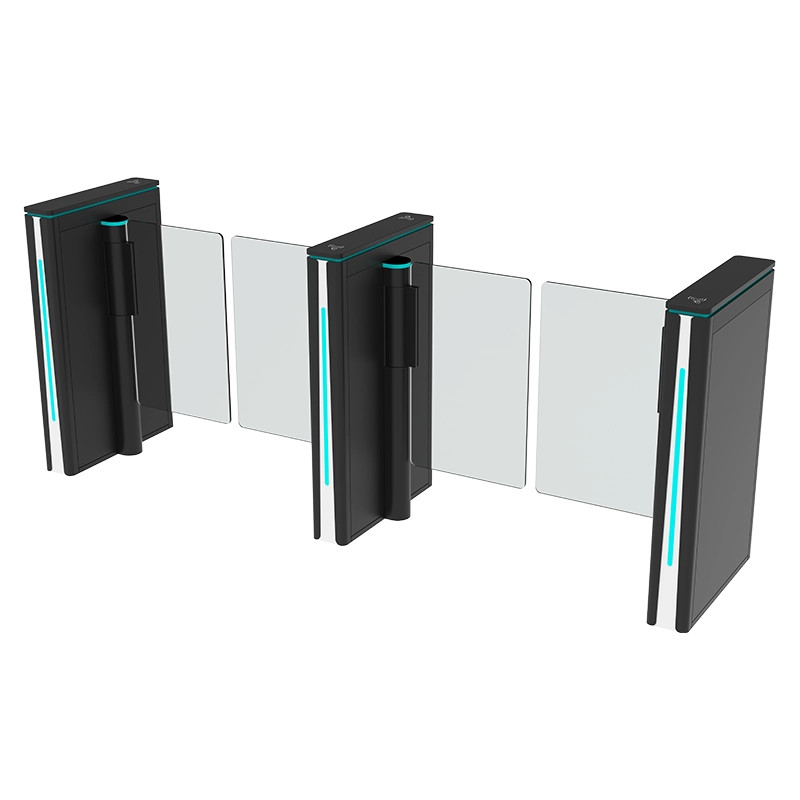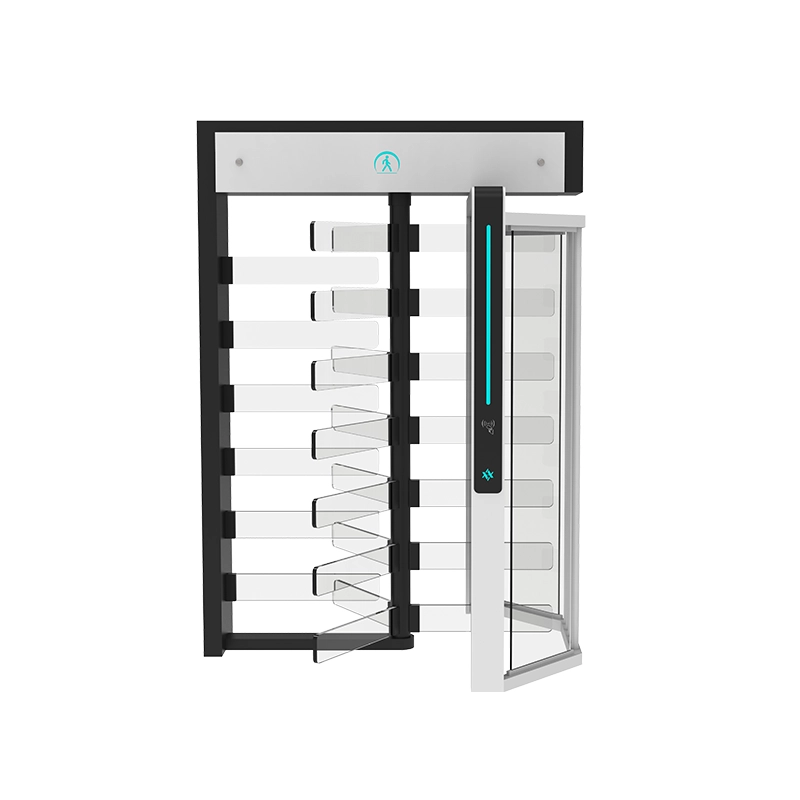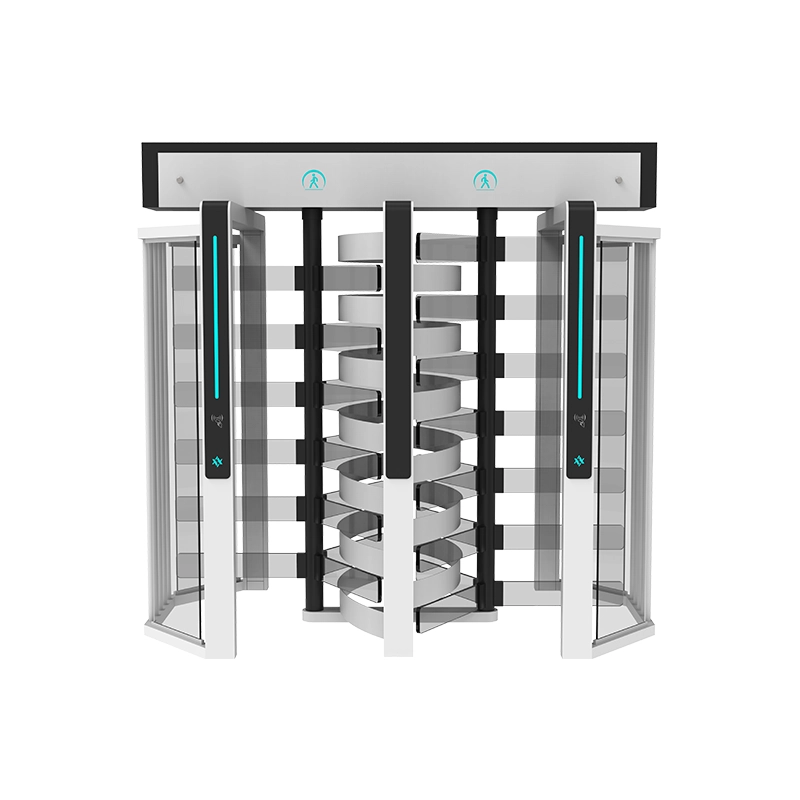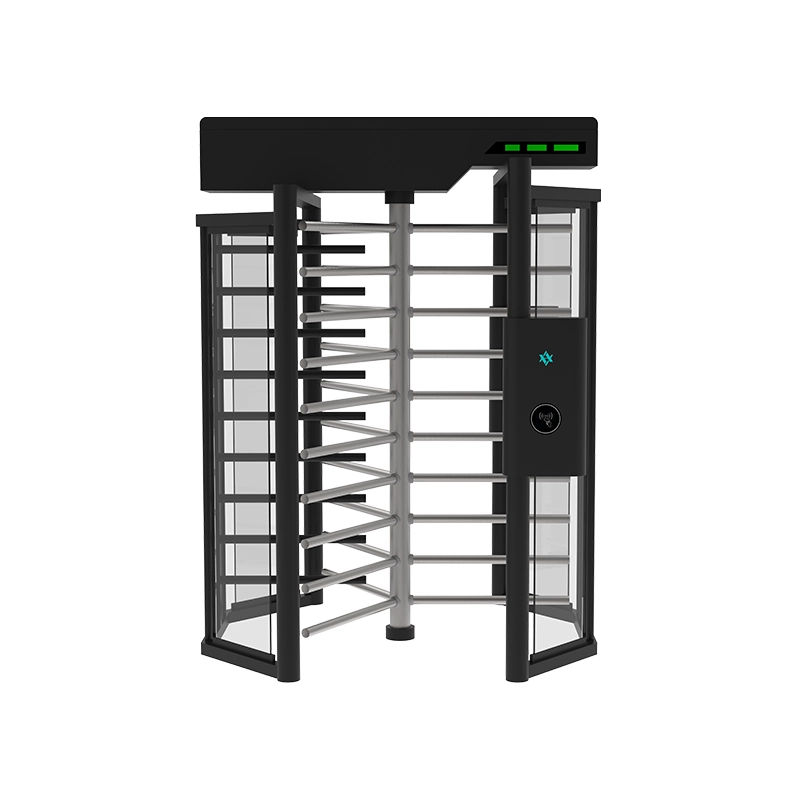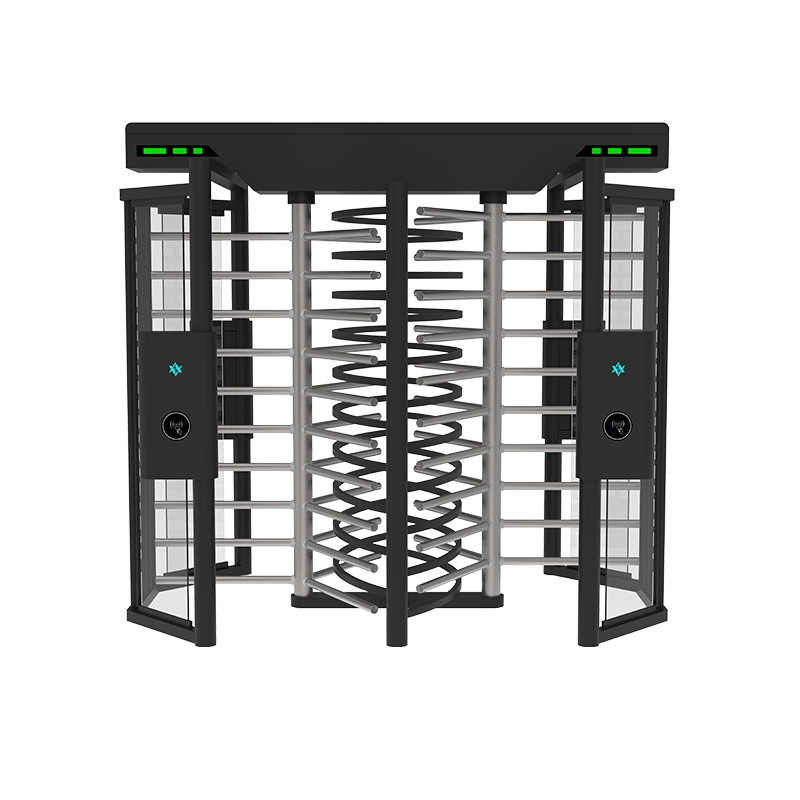

Two commercial speed gates can look identical in a product photo and behave completely differently in a lobby at 8:45 on a Monday. The difference sits in six specification items that most quotations state vaguely. Each one changes both the unit cost and the lane count your building needs, so check them before comparing price per lane.

What to Check Before Buying Speed Gates
Throughput per Minute
Throughput is the number of authorized passages one lane completes in a minute. A commercial mechanism cycles in roughly 0.5 to 1.0 seconds, which yields a theoretical 40 to 60 passages per minute. Real throughput is far lower, because the bottleneck is the credential reader and the person using it.
Plan with these figures: a card or QR lane handles 25 to 35 people per minute, a biometric lane 15 to 25, and a lane mixing staff with manually verified visitors 8 to 15. Ask for the gate’s own cycle time separately from reader timing, and confirm it applies to continuous operation.
Motor Type and Drive
Three drive designs dominate the market, and the difference shows up in noise, service interval, and failure behavior.
- Brushed DC motor with belt drive. Lowest cost. Audible belt noise, brush wear, shorter service interval. Workable on a low-traffic back door; a poor match for a main lobby.
- Brushless DC (BLDC) servo motor with encoder. The mainstream commercial choice. Quiet, with position feedback and controlled acceleration.
- Servo motor with planetary gear reduction. Highest torque, quietest operation, used with wide barriers, heavy glass wings, or very high cycle counts. Also the most expensive.
Two questions matter more than the motor name. What happens on power loss — does the barrier open freely (fail-safe), stay locked (fail-secure), or does a battery finish the cycle? And can a person push the barrier open by hand if the drive fails? On a fire egress path, a fail-safe release wired to the alarm panel is usually a code requirement. The working principle and types of turnstiles explains how the drive, brake, and clutch interact across barrier designs.
Infrared Sensor Pair Count
Infrared sensor pairs are the beams that tell the controller where people are inside the lane. A minimal gate uses six pairs, three along each side; a commercial-grade lane uses eight to twelve, arranged in vertical and horizontal arrays. With twelve pairs the controller can separate one person from two walking side by side, hold the barrier open for a trailing person with a stroller, and confirm the lane is empty before the closing timer expires. With four to six pairs the gate can only tell that something broke a beam, which turns tailgating prevention into a matter of timing luck. Ask for the pair count and the mounting layout drawing, not just the datasheet number.
MCBF (Mean Cycles Between Failures)
MCBF is expressed in millions of cycles and describes how many open and close operations the mechanism should complete before a failure. Reference values from Chinese manufacturers run about 3 million cycles at entry tier, 5 million at mid tier, and 8 to 10 million at premium tier. Treat MCBF as a comparison tool, not a promise: ask how the number was derived, and expect a credible answer to name the stroke angle, load, cycle rate, and which component counted as a failure.
Lane Width
Standard commercial lane width is 550 to 600 mm (21.7 to 23.6 in). This is deliberately narrow, because a narrow lane discourages two people entering side by side, which is the main physical defense against tailgating. An accessible lane needs a clear width of at least 900 mm (35.4 in); 915 mm is a common specification, and it normally requires a longer barrier and a stronger mechanism. Plan at least one accessible lane per entrance, placed at the outer edge so a wheelchair user does not cross other lanes. If that lane must also pass luggage carts or cleaning trolleys, consider 900 to 1000 mm with a slower closing speed.
Safety Photocell Layout
Photocell count is only half the story; placement decides what the gate can actually protect. A well-designed lane separates its beams into three groups: safety beams inside the lane at ankle, knee, waist, and chest height; directional beams at the entrance that confirm approach and direction; and anti-tailgating beams positioned so two consecutive people break separate beams. Ask for mounting heights in millimeters, not a beam count. A gate with ten beams clustered between 500 and 800 mm protects adults but can miss a child, a wheelchair footrest, or a low luggage trolley. Beams below 300 mm and above 1000 mm are what make a lane genuinely safe for mixed traffic.
| Specification item | Entry-level gate | Commercial-grade gate | Why it matters on site |
|---|---|---|---|
| Motor and drive | Brushed DC, belt drive | BLDC servo with encoder | Noise, service interval, behavior on power loss |
| Realistic throughput | 20–25 passages/min with card reader | 30–35 passages/min with card reader | Determines how many lanes the lobby needs at peak |
| Infrared sensor pairs | 4–6 | 8–12 | Tailgating prevention, closing safety, direction logic |
| MCBF | 3 million cycles | 5–10 million cycles | Expected service life before mechanism overhaul |
| Lane width | 550 mm only | 550–600 mm plus a 900 mm accessible lane | Footprint and barrier-free access compliance |
| Safety photocell layout | Single-height beams | Multi-height, below 300 mm to above 1000 mm | Protection for children, wheelchair users, luggage |
| Fail-safe release | Optional | Standard, wired to fire alarm input | Egress and fire code compliance |
Typical Speed Gate Configurations for Commercial Buildings
Speed gate lanes are built from two cabinet types. A single-core cabinet holds one mechanism and one barrier and forms the outer end of a lane. A dual-core cabinet holds two mechanisms facing opposite directions and is shared between adjacent lanes. That is why the cabinet count never matches the lane count. The arithmetic is lanes plus one equals cabinets: one lane needs two single-core cabinets, two lanes need three, four lanes need five. This is the most common quantity error in speed gate procurement, and the easiest way to make a quotation look cheaper than it is.
Single-Lane Layout
Two cabinets, one lane, typically one direction unless bidirectional readers are fitted. Suitable for a staff door, service corridor, or gym. Footprint runs about 2.0 to 2.6 m. There is no redundancy: if a mechanism or reader fails, the entrance must be opened manually until repaired. Acceptable at a secondary entrance, rarely acceptable in a main lobby.
Two-Lane Layout
Three cabinets, two lanes, usually one entry and one exit. The most common configuration for mid-size offices, clinics, and reception areas handling 300 to 1,200 people per day. Two lanes give basic redundancy, which often prevents queues building at reception. Above roughly 40 people per minute at peak, two lanes get tight and the queue forms outside the barriers.
Four-Lane Layout
Five cabinets, four lanes, typically two entry and two exit, or three entry and one exit where arrivals are concentrated in the morning. Suitable for corporate headquarters, government service halls, transport interchanges, and hospital main entrances. Four lanes allow a dedicated accessible lane without cutting general capacity, and the software can switch a lane’s direction by time of day.
| Entrance type | Lanes | Cabinets required | Typical daily volume |
|---|---|---|---|
| Secondary staff door | 1 | 2 single-core | Up to 500 people |
| Mid-size office reception | 2 | 2 single-core + 1 dual-core | 300–1,200 people |
| Corporate headquarters lobby | 4 | 2 single-core + 3 dual-core | 1,000–4,000 people |
| Hospital or government hall | 4–6 | N + 1 cabinets total | 2,000–8,000 people |
Speed Gate Price Ranges and What Changes Them
As a market reference, Chinese ex-works pricing for commercial speed gates currently sits at roughly USD $1,000 to $3,500 per lane. That spread of more than three times reflects drive type, sensor count, material grade, reader integration, and controller capability. Treat it as a budgeting range only — an accurate figure requires a quotation against a defined lane configuration and delivery term.
The largest driver is the drive and mechanism. A brushed DC belt-drive lane and a servo-driven lane with planetary reduction are different products at roughly opposite ends of the range. Sensor count is second: moving from six pairs to twelve adds hardware, controller inputs, and engineering time. Cabinet material is third. Grade 304 and grade 316 stainless differ substantially in cost, and panel thickness of 1.2, 1.5, or 2.0 mm changes both weight and price.
Two costing traps are worth naming. First, comparing a gate-only price against a package that includes readers, controller, and software — those are not the same product, and the gap can exceed the gate price itself. Second, comparing an ex-works price against a delivered price; freight, insurance, duty, clearance, inland transport, installation, and commissioning all appear after the factory invoice. For a full breakdown of how costs accumulate from factory floor to installed lane, see the speed gate price and cost guide.
| Cost driver | Effect on per-lane price | When the higher option is justified |
|---|---|---|
| Drive type | Largest single factor | High cycle counts, quiet lobbies, wide or heavy barriers |
| Sensor pair count | Moderate, 6 pairs to 12 | Any lane where tailgating prevention is a stated requirement |
| Steel grade and thickness | Moderate to significant | Coastal, humid, or high-touch public environments |
| Reader and controller supply | Can exceed the gate price | When you want one accountable supplier for the full lane |
| Custom finish and dimensions | Small per unit, high if tooling is needed | Branded corporate lobbies and multi-building rollouts |
| Order quantity and batch | Lowers per-lane price at volume | Multi-lane or multi-site projects ordered together |
Buying Direct From the Manufacturer vs a Distributor
Both channels are legitimate, and the right answer depends on what your project values most. A local distributor solves installation, service response, and code familiarity. A factory solves price, customization, and direct access to the engineering team. Problems start when a distributor is expected to price like a factory, or when a buyer goes direct without the internal capability to handle integration and commissioning.
| Factor | Direct from manufacturer | Distributor or reseller |
|---|---|---|
| Unit price | Factory ex-works pricing, middle margin removed | Includes distributor margin, local stock, and overhead |
| Customization | Lane width, finish, dimensions, logo, and reader cut-outs engineered to order | Limited to catalog options the distributor stocks |
| Lead time | 7–15 days production plus international transit | Faster if in local stock, slower for non-stock items |
| Technical support | Direct to the engineering team by email, video, or remote session | Local first-line support, escalates to the factory |
| Minimum order | As low as 1 unit for standard models | Often 1 unit from stock; custom items need a batch |
| Spare parts | Ordered against the part number, usually cheaper | Immediate availability at a marked-up price |
| Installation and commissioning | Buyer arranges locally, or a factory technician is dispatched | Usually included or offered as a local service |
| Local code knowledge | Limited; buyer confirms local requirements | Strong; the distributor works with local codes daily |
| Commercial risk | Requires due diligence and clear payment terms | Lower transaction risk, higher cost of change |
The trade-off reduces to three questions. How much customization does your entrance need? How much integration work can your own team or contractor absorb? And how important is a two-hour on-site service response versus a two-day remote diagnosis? Where the answers point to a standard product, capable local installation, and remote support, buying direct usually wins on total cost. A framework for vetting the factory itself — in-house fabrication, drawing issue, firmware access, and audit evidence — is set out in the speed gate manufacturer selection guide.
Ordering Process and Lead Times From China
A speed gate order from a Chinese manufacturer follows a predictable path. Knowing the sequence prevents most disputes, because each step produces a document you can check before the next one starts.
- RFQ submitted. Send your entrance drawing, lane count, reader type, finish, destination, and deadline. A drawing is worth more than a paragraph of description.
- Offer returned. It should itemize cabinets, barriers, sensor arrays, controller, accessories, packing, and any readers supplied, against a named delivery term and port.
- Approval drawing signed. Dimensions, lane widths, reader openings, cable entries, and fixing details are confirmed. Nothing enters production before signature.
- Deposit paid. AIPADA works on T/T with a 30% deposit and the balance before shipment.
- Production. Standard commercial speed gates are built in 7 to 15 days from the deposit or from drawing approval, whichever the order specifies.
- Factory testing. Ordered units are assembled and run through opening, closing, obstruction, and alarm tests, documented with photos or video showing serial numbers.
- Packing and dispatch. Cabinets are braced, barrier panels packed separately with edge protection, and electronics moisture-protected. Package count, weight, and dimensions ship with the packing list.
- Shipping and customs clearance, by sea, air, or courier depending on schedule.
- Installation and commissioning by your local contractor or a dispatched factory technician.
| Method | Typical transit time | Best used when |
|---|---|---|
| Sea freight, LCL | 25–45 days door to door | 1–3 lanes and a flexible schedule |
| Sea freight, FCL | 20–40 days port to port | 4+ lanes or a full project order |
| Air freight | 5–10 days door to door | Schedule-critical single lanes |
| Express courier | 3–7 days door to door | Spare parts, sensors, control boards, samples |
What AIPADA’s Warranty and Technical Support Covers
AIPADA provides a 2-year warranty plus lifetime technical support on speed gates and turnstiles.
- Two years of coverage on the mechanism, drive, controller, sensor arrays, and factory-supplied components, counted from shipment or delivery as stated in the order. Confirm the start point before ordering.
- Replacement of defective factory-supplied parts at no component cost. Freight on replacement parts and local labor are normally the buyer’s responsibility unless agreed otherwise.
- Lifetime technical support with no time limit on remote troubleshooting, wiring diagrams, parameter files, and integration guidance for third-party readers or controllers not purchased from AIPADA.
- Standard exclusions: physical damage, water ingress where the cabinet is not rated for it, unauthorized modification, incorrect supply voltage, and wear items such as belts and sensor windows.
Because the support model is remote-first, its value depends on documentation. AIPADA supplies wiring diagrams, installation instructions, and parameter references with the order, and supports diagnosis by email, WhatsApp, and video call. A short video of the fault plus the unit serial number resolves most integration problems without a site visit.

Entry, Mid-Range, and Premium Speed Gate Spec Comparison
The three tiers below reflect the range of configurations available from Chinese manufacturers. They are not fixed product lines, since most factories build any combination, but they show where the money goes and what each tier suits.
| Specification | Entry tier | Mid tier | Premium tier |
|---|---|---|---|
| Indicative ex-works price per lane | USD $1,000–1,600 | USD $1,600–2,500 | USD $2,500–3,500+ |
| Drive | Brushed DC, belt drive | BLDC servo with encoder | Servo with planetary gear reduction |
| Sensor pairs | 4–6 | 8–10 | 10–12, multi-height arrays |
| MCBF | 3 million cycles | 5 million cycles | 8–10 million cycles |
| Cabinet material | 304 stainless, 1.2 mm | 304 stainless, 1.5 mm | 304 or 316 stainless, 1.5–2.0 mm |
| Barrier panel | Acrylic or thin glass | Tempered glass, 8–10 mm | Laminated or tempered, 10–12 mm |
| Lane width | 550 mm standard | 550–600 mm, 900 mm accessible option | Custom, including 900–1000 mm |
| Reader integration | Dry contact interface, buyer-supplied readers | Prepared cut-outs and wiring terminals | Full package with controller and software |
| Fail-safe and fire input | Optional | Standard | Standard with battery backup option |
| Best suited to | Secondary entrances, low traffic | Office lobbies, clinics, schools | Hospitals, transit, 2,000+ people per day |
The price gap between tiers is driven mainly by the drive mechanism and the sensor array; cosmetic differences move the price very little. If the budget is tight, keep a mid-tier drive and sensor package and economize on finish and branding, rather than stepping down to a brushed motor in a main lobby.
Common Pitfalls in Speed Gate RFQs
- Quoting per cabinet instead of per lane. A low number may simply mean half the equipment. Ask how many cabinets and lanes the price covers, and check it against a lane drawing.
- A gate-only price compared against a complete package. Readers, controllers, power supplies, software, and cables can exceed the gate cost.
- An incomplete delivery term. “FOB” without a named port, or “CIF” without a destination, is not usable information. Require the term, port, currency, and validity period.
- An unclear lead time start point. Seven to fifteen days from the deposit is different from seven to fifteen days from drawing approval or receipt of buyer-supplied readers.
- Assuming an accessible lane is included. A 550 mm lane does not meet barrier-free requirements.
- No fire alarm interface specified. On an egress route, release behavior and alarm input must be stated and tested, not assumed.
- Skipping the approval drawing. A verbal “we can customize it” is not a production instruction. Every dimension, opening, and finish belongs on a signed revision.
- Forgetting spares. Sensor modules, control boards, power supplies, and belts cost little to ship inside the original consignment and are slow and expensive to send later.
- Ignoring the electrical environment. Confirm voltage and frequency, and whether the site needs 110 V or 220 V. A mismatch found at installation is an avoidable delay.

Frequently Asked Questions
Can I buy a single speed gate lane as a trial?
Yes. AIPADA’s minimum order quantity is one unit for standard models, which makes a pilot installation practical. Confirm that the trial unit uses standard production components rather than a hand-built sample, and that the same configuration, controller version, and finish can be reproduced in a later volume order. Record the model code, firmware version, sensor configuration, and finish reference so a repeat order placed months later matches.
Are speed gates priced by lane or by cabinet?
Both practices exist, which is why the question matters. A lane is formed by cabinets on both sides, and in multi-lane layouts the middle cabinets are shared between two lanes. Request a lane drawing plus an itemized bill of materials showing single-core and dual-core quantities. Lanes plus one equals cabinets: a four-lane bank uses five cabinets, not four.
Can a factory prepare a gate to work with my existing access control system?
Usually yes, provided you supply the reader dimensions, mounting requirements, supply voltage, wiring, and interface type before the approval drawing is signed. A correctly sized opening does not by itself confirm electrical or software compatibility. Send the reader datasheet to the factory, have compatibility confirmed in writing, and include an interface test in the factory acceptance test.
How long does an order from China take end to end?
Production runs 7 to 15 days for standard commercial speed gates, starting from the deposit or from signed drawing approval. Add export packing and documentation, then transit: roughly 5 to 10 days by air, or 20 to 45 days by sea. Customs clearance and inland delivery add further time. As a planning figure, allow six to eight weeks from purchase order to installed lanes by sea, and three to four weeks by air.
Should I choose the cheapest speed gates for sale?
Only after normalizing scope. Add the omitted readers, controller, packing, freight, duty, installation, commissioning, spares, and support to each offer before comparing totals. Once the scope matches, a cheaper lane can still be right for a secondary entrance with light traffic. In a main lobby running thousands of passages per day, the mechanism and sensor spec determines whether the gate is still reliable in year five.
Next Step: Getting a Quotation You Can Compare
Commercial speed gates are a configured product, not a catalog item, and price depends on decisions only you can make: lane count, lane width, credentials, finish, and delivery term. A useful quotation starts with four pieces of information — your entrance drawing, the required lane count and widths, the reader type you plan to use, and your destination port or city.
AIPADA is a Chinese speed gate manufacturer based in Shenzhen, founded in 2014, with a 3,000 m² factory at Building 19, Guorun Industrial Park, Tangxia Town, Dongguan, an 80-person team, and monthly capacity of 3,000 units. Speed gates carry CE certification (certificate no. ZR0119400918C) and a CMA and CNAS accredited test report (UCT1648D35), plus one design patent and four software copyrights. Standard terms are one unit minimum order, 7 to 15 days production, T/T with a 30% deposit, a 2-year warranty, and lifetime technical support.
To compare configurations before requesting pricing, review the commercial speed gate turnstile range. If you are also specifying readers, controllers, and credentials, the access control product range covers the integration side of the lane.
To request an itemized proposal, send your entrance drawing, lane requirement, reader information, finish preference, and delivery destination to info@aipadaturnstile.com or via WhatsApp at +86 191 2995 1956. State whether you want gate hardware only, an integration-ready package, or a complete entrance package, so every line item in the offer traces back to a requirement.