](https://aipadaturnstile.com/wp-content/uploads/2026/04/What-is-a-Full-Height-Turnstile-and-Why-Use-One.jpg "What is a Full Height Turnstile and Why Use One")

A full height turnstile is the only pedestrian access gate that stops a person physically rather than electronically. Flap barriers, speed gates, and tripod turnstiles rely on a credential and a sensor to decide who gets through. A full height turnstile relies on geometry: a rotor of steel arms inside a floor-to-overhead frame, divided into compartments sized for one body. If two people enter one compartment, the rotor cannot finish its rotation.
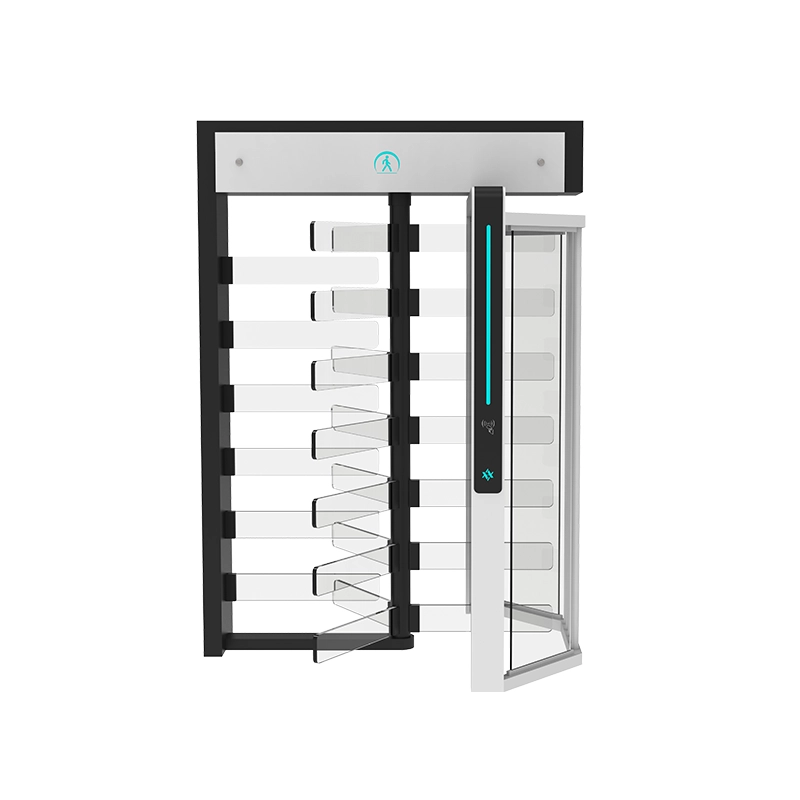
A full height turnstile is a floor-to-overhead pedestrian gate in which a rotor of three or four arms turns inside a rigid frame, forming enclosed compartments that admit one authorized person per rotation. The barrier is one continuous plane of steel from floor to lintel, so it blocks tailgating, climbing, and crawling without a guard.
That is why full height turnstiles are still specified for construction sites, stadium perimeters, correctional facilities, borders, and unstaffed industrial gates. This guide covers the rotor mechanism, lane configurations, rotor geometry, pricing, and outdoor specification.
What Is a Full Height Turnstile Gate?
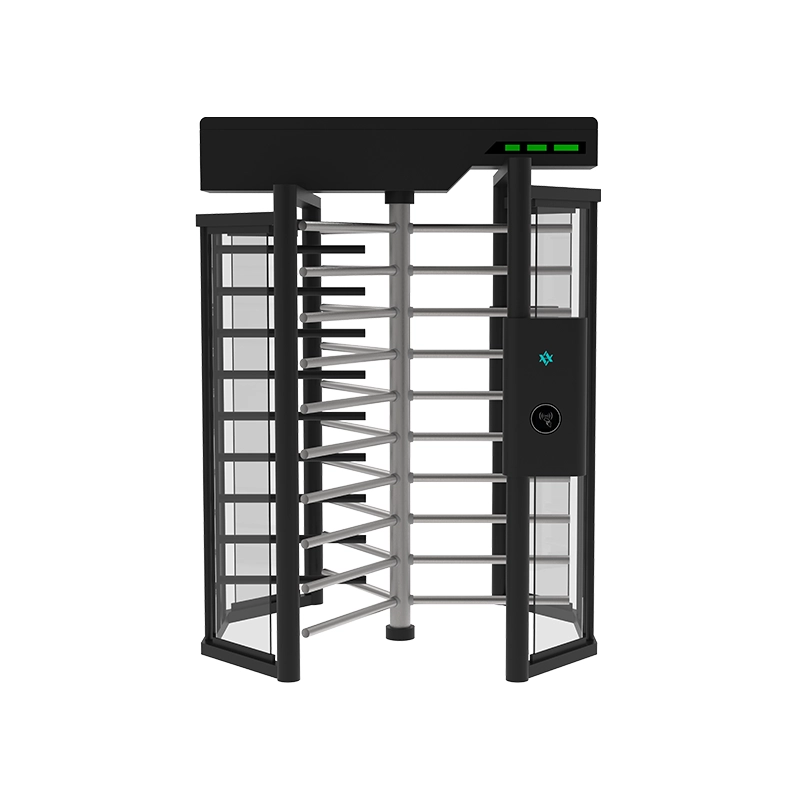
A full height turnstile gate is a steel cage with one moving part: the rotor. It turns on a center column inside a frame of two vertical end posts and a top cross-member, the lintel. Rotor arms sweep past fixed arms welded to the frame, and the space between a moving arm and a fixed arm becomes a compartment. A person steps in, the rotor indexes one position, and the compartment behind closes as the next opens.
The Floor-to-Overhead Barrier, Explained
Nothing is left open. A waist-high turnstile stops you at the hip; a full height turnstile stops you at the top of the rotor, roughly 1.9 to 2.3 meters up, with the frame closing the gap to the lintel. There is no leg gap to crawl through, no top rail to swing over, and no side gap to squeeze past.
What “Full Height” Means in Real Dimensions
“Full height” is not one size but a narrow family:
- Overall height: 2.1–2.3 m (about 7–7.5 ft), with rotor arms at 1.9–2.2 m — the dimension that must exceed realistic vaulting reach.
- Single lane clear width: 550–650 mm between the rotor and the fixed side arms, enough for a person with a backpack but not for two people side by side.
- Accessible bypass: a full height lane is never the accessible route; a swing gate or wide flap barrier on the same controller handles wheelchairs and deliveries.
If a supplier calls a 1.5 m gate a full height turnstile, it is a waist-high unit with marketing on top.
The One-Person-Per-Compartment Principle
Compartment geometry is the security mechanism. A three-arm rotor creates three 120° compartments; a four-arm rotor creates four at 90°. Depth from the entry plane to the hub sweep is set so one adult fits and two do not. When a second person slips in behind the first, their body occupies the wedge the trailing arm must sweep through — the arm lands on them, the rotor stalls, and the gate does not advance.
How Rotary Rotor Systems Work
The moving parts are the rotor hub and arms, the center column and bearings, the index detent, the anti-reverse pawl, and the locking pawl with its release solenoid.
Rotor Hub, Arms, and the Detent Mechanism
The rotor turns on a thrust-and-radial bearing set around the center column. Inside the housing sit the parts that control behavior:
- Indexing detent: a spring-loaded roller that drops into a notch on the rotor cam at each rest position, holding the rotor square in 90° or 120° increments so the entry never stops half-open.
- Anti-reverse ratchet: a pawl allowing rotation one way only, so nobody inside can push the arms back to reopen the entry behind them.
- Locking pawl and solenoid: spring-engaged, solenoid-released. No credential, no release.
- Damper: stops a two-meter rotor slamming into the detent.
A Complete Access Cycle
- The user presents a card, fob, ticket, or biometric at the reader.
- The controller validates it and energizes the solenoid for a few seconds.
- The locking pawl retracts and the rotor can turn in the permitted direction.
- The user pushes the arm through one index position; the trailing arm sweeps closed behind them.
- The detent drops into the next notch and the pawl re-engages until the next valid credential.
One credential, one rotation, one person — and every release is logged.
Free-Spin, Fire Egress, and Fail-Safe Options
Life safety needs explicit specification. Three modes matter:
- Fail-safe free-spin: on power loss or a fire alarm signal the solenoid de-energizes and the rotor spins freely both ways, so occupants push straight through without a credential.
- Fail-lock with panic release: the rotor stays locked until a monitored input from the fire panel or a break-glass point drops the pawl.
- Drop-arm variants: arms fold away to clear the lane for equipment or stretchers.
Drive Types, Integration, and Materials
Full height turnstiles are almost always push-to-turn: the motor is you. That keeps the mechanism reliable in rain and dust; motorized versions exist but add cost and failure points. The rotor lock accepts a dry contact or Wiegand/OSDP signal, so it runs on RFID, QR tickets, facial recognition, or a reception push button. AIPADA supplies matching readers, controllers, and access control hardware and publishes an overview of the working principles and types of turnstiles.
Single-Lane vs Double-Lane (Dual Rotor) Full Height Turnstiles
“Double” is used two ways, so decide how many independent lanes you need and which direction each runs before you open a catalogue.
Single-Lane, Single-Rotor Units
The standard unit is one rotor in one frame — one lane, configured three ways: entry only, exit only, or bi-directional, where the rotor releases either way depending on the credential. A bi-directional single lane is the cheapest way to get full physical control of a passage.
Dual Rotor and Double-Lane Configurations
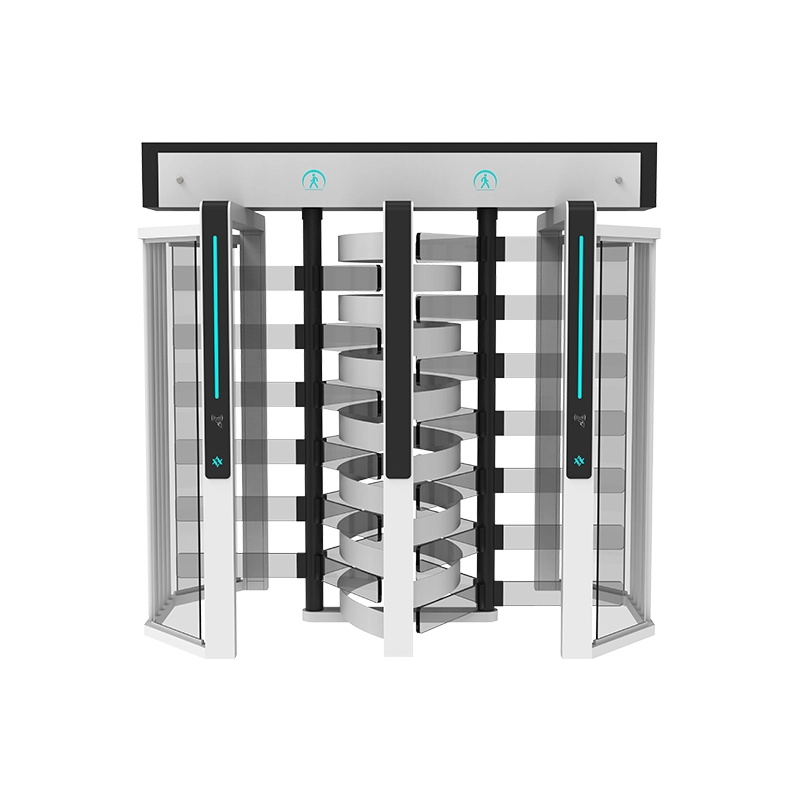
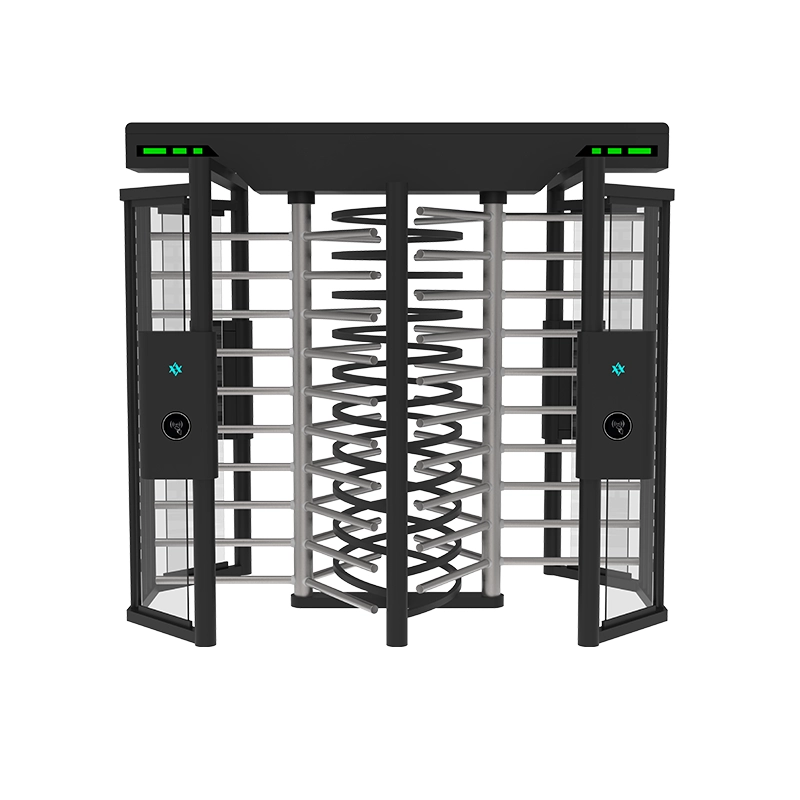
A dual rotor unit — sold as a “double full height turnstile” — carries two independent rotors in one frame or two frames sharing a center column, giving two lanes in a footprint narrower than two stand-alone gates:
- Entry plus exit in one cabinet: the left rotor runs inbound and the right outbound.
- Two lanes in the same direction: both rotors inbound with separate readers, doubling throughput at a shift-change gate.
- Two lanes, two credential types: employees on biometrics, visitors on temporary QR tickets.
Each rotor must have its own hub, detent, pawl, and solenoid; cheaper units share one lock, so a single solenoid failure closes both lanes.
Which Configuration Should You Specify?
- One lane, low risk: a single bi-directional rotor is enough and is the lowest cost point.
- One doorway, simultaneous in and out: a dual rotor entry/exit cabinet keeps queues from crossing.
- Shift-change surges or a high-security boundary: plan two rotors, or two rotors set as an interlocked pair so the second releases only after the first completes its rotation.
Compare cabinet sizes and rotor arrangements in the full height turnstile range.
90-Degree and 120-Degree Rotor Options
The 90-Degree, Four-Arm Rotor
Four arms create four 90° compartments. Each rotation advances the user a quarter turn, and at rest two arms form a cross that seals the lane. Compartments are smaller, so the gate is compact and efficient per rotation, but users with large bags or broad shoulders feel the enclosure more and anyone entering off-center may contact the trailing arm.
The 120-Degree, Three-Arm Rotor
Three arms create three 120° compartments — a wider wedge per person, more swing room, and a far more forgiving entry, so users hesitate and jam less. Each rotation covers 120° rather than 90°, so the sweep takes marginally longer and the frame is slightly larger. This is the more common choice outdoors and for facial recognition lanes where the user must pause inside the compartment to be verified.
Choosing Between Them
Pick 90° when space is tight and users arrive unencumbered; pick 120° when users wear PPE, carry equipment, or must stand still inside the compartment. Confirm three details either way: the detent holds the rotor square, the anti-reverse pawl is present, and the damper suits the rotor’s mass.
Security Level: Why Full Height Is the Only Gate That Physically Blocks Tailgating
Every entry method has a failure mode, which is why full height turnstiles command a premium over faster gates.
Tailgating, Piggybacking, and the Cost of One Unauthorized Person
Tailgating is one person following another through a gate that authorized only the first; piggybacking is the polite version, where the second person is invited. Both defeat a credential system entirely, because the credential was valid — it was simply used by more than one body. At a data center the cost is a breach; at a construction site it is stolen tools plus liability for an untrained person on site.
Why Sensors Detect but Do Not Stop
Speed gates and flap barriers use infrared curtains or overhead cameras to count bodies and flag a second person. That is detection, not prevention: the gate can alarm and log, but the person is already inside, and an alarm that fires repeatedly gets muted by staff within a week. Detection works when a human responds; a rotor works when nobody is watching.
Climb-Over, Crawl-Under, and Push-Through Resistance
- Climb-over: a 1.9–2.2 m rotor closed to the lintel puts the top beyond a normal vault, and smooth tubular arms offer no handhold.
- Crawl-under: there is no under — the compartment floor is continuous and the arms sweep to floor level.
- Push-through: the anti-reverse pawl and mechanical lock resist levering in one direction, and the fixed arms carry the load.
- Squeeze-through: a 550–650 mm lane will not admit two adults side by side.
The Limits: What a Full Height Turnstile Does Not Solve
A single rotor stops tailgating, not a coordinated pair using one valid credential and a forced rotation. For that threat you need an interlocked pair, a two-rotor airlock, or a dedicated mantrap.
Full Height Turnstile Selection Table
Use this as a specification worksheet. A manufacturer can only quote accurately once throughput, lane width, and material grade are fixed.
| Specification | Typical Range | What to Ask For | Why It Matters |
|---|---|---|---|
| Throughput per lane | 15–25 persons per minute | Peak headcount per shift, not average | Full height gates intentionally slow passage; under-sizing creates queues |
| Clear lane width | 550–650 mm single lane | The internal clear dimension on the drawing | Two adults must not fit side by side; too narrow jams users with bags |
| Rotor configuration | Single rotor; dual rotor (two lanes) | Lanes, direction per lane, independent locks | Determines footprint, cost, and whether one fault closes both lanes |
| Overall height | 2.1–2.3 m; arms 1.9–2.2 m | A dimensioned drawing, not a marketing height | The barrier must exceed realistic vaulting reach |
| Material and thickness | 304 stainless; arms 1.5–2.0 mm; frame 1.2–2.0 mm | Wall thickness in writing, per component | Thin-wall frames flex under impact; thick frames stay true |
| Finish | Brushed stainless; galvanized plus powder coat for steel | The real environment: inland, coastal, or chemically aggressive | The wrong finish rusts within two seasons on tropical coastlines |
| Ingress protection | IP54 indoor; IP65 outdoor lock and reader | IP65 for any lane not under a roof | Drives solenoid and reader reliability through the wet season |
| Egress mode | Fail-safe free-spin; fail-lock with panic release | Wiring, alarm input, and battery backup behavior | Fire code compliance and occupant safety |
Where Full Height Turnstiles Earn Their Cost
These gates go where the cost of one unauthorized person exceeds the cost of the gate many times over.
Construction Sites
A large site can lose tools and copper at a rate that dwarfs the gate budget. A full height turnstile at the worker entrance, driven by RFID or facial recognition, enforces the induction check: no valid badge, no entry, plus a controller log that doubles as your attendance record.
Stadiums and Event Venues
Venues use full height turnstiles where a credential must map to exactly one person: player and staff zones, media areas, and controlled perimeter gates. Free-spin egress must be wired to the venue alarm system and tested before every event, and ticket scanning plus a one-person rotor produces an accurate headcount.
Prisons and Correctional Facilities
The classic application. Full height turnstiles control staff movement between security zones, work with sally port and interlock logic, and present no handholds or gaps to exploit. Anti-climb cladding, tamper-resistant fixings, and a lock mechanism with no exposed fasteners are standard. At the highest-risk boundary, pair the rotor with an interlocked second barrier.
Borders and Immigration Checkpoints
At controlled crossing points a full height rotor enforces one-person-at-a-time presentation, which is exactly what biometric and passport verification requires: the user stands in a sealed compartment during the check and the gate releases only on a positive match.
Factories and Industrial Plants
Shift-change control is the driver. Two dual-rotor units at a main gate can process a shift while keeping the perimeter closed, and separate rotors for employees and contractors keep the credential database clean. Full height gates also fit chemical and pharmaceutical plants where controlled-area boundaries must be real.
Unstaffed and Remote Sites
Cell towers, substations, and remote logistics yards cannot justify a guard. A full height turnstile with a reader, controller, and intercom gives genuine physical control at a fraction of a guard’s annual cost, and a monitored alarm input still generates a record after hours.
Full Height vs Waist-High vs Speed Gate
The three families solve different problems. If your requirement is speed, a speed gate wins. If your requirement is exclusion without staff, only the full height rotor delivers.
| Attribute | Full Height Turnstile | Waist-High (Tripod / Flap) | Speed Gate |
|---|---|---|---|
| Barrier height | Floor to 2.1–2.3 m | About 1.0–1.1 m | About 0.9–1.8 m wings |
| Tailgating prevention | Physical — one person per compartment | Deterrent plus sensor detection | Sensor detection with alarm |
| Climb-over risk | Very low — above vaulting reach | High — climbable or steppable | Moderate — wings can be climbed |
| Throughput per lane | 15–25 per minute | 25–40 (tripod); 30–45 (flap) | 40–60+ per minute |
| Accessible route | Needs a separate wide bypass lane | Tripod cannot; wide flap can | Wide models can serve accessible routes |
| Outdoor suitability | Excellent with IP65 and the right finish | Good with canopy or correct finish | Typically indoor or sheltered |
| Best-fit sites | Construction, prisons, borders, stadium perimeters | Offices, gyms, factories, libraries, transit | Corporate lobbies, airports, data centers |
If your requirement sits in the middle of that table — controlled entry, a human nearby, steady flow — a waist-high unit may be the rational choice and costs less. Our tripod turnstile guide walks through that sizing exercise, and the tripod turnstile range covers the configurations available if the middle tier is enough.
Price and Total Cost of Ownership
They are not expensive because the parts are exotic; they are expensive because they use roughly three times the stainless steel of a waist-high gate and a heavier locking mechanism to match.
Market Reference Price Range
As a China ex-works market reference, full height turnstiles generally fall in the range of USD $600 to $2,000 per lane. That spread is driven by specification rather than brand:
- Lower end (~$600–900): single rotor, 90° arms, thinner-wall 304 stainless, mechanical push-to-turn, basic lock and solenoid.
- Mid range (~$900–1,400): heavier frame, 120° rotor option, damper, IP65 lock and reader mounting, matched controller.
- Upper range (~$1,400–2,000+): dual rotor two-lane cabinet, biometric integration, free-spin egress with alarm interface, hot-dip galvanized plus powder-coated frame, anti-climb cladding.
Freight, duties, installation, concrete work, cabling, and the access control system all sit outside the ex-works price, so an exact number needs a quote against a dimensioned drawing.
What Moves the Price, and What You Pay Later
In rough order of impact: number of rotors (one versus two is close to a doubling of mechanical cost), material grade and wall thickness, locking mechanism and drive type, electronics, and outdoor finish. Over ten years, ownership cost is dominated by maintenance discipline rather than parts price. Plan a six-month inspection to lubricate bearings and the pawl pivot, check the detent roller and damper, and verify anchor torque; an annual service to test the egress release and check finish integrity; and keep a detent roller, damper, solenoid, and bearing set on the shelf. There is no drive belt, no glass panel, and no sensor curtain to recalibrate.
Corrosion and UV: Specifying for Outdoor Installations
Most full height turnstiles sit outdoors, and most premature failures are finish failures rather than mechanism failures.
Stainless Steel, Hot-Dip Galvanizing, and Powder Coating
- 304 stainless, brushed or satin: the default for visible exposed structures. In coastal air, specify 316 stainless for fixings, bearings, and any component that stays wet.
- Hot-dip galvanizing: the frame is dipped in molten zinc, producing a bonded zinc-iron coating typically 60–85 µm thick. This is sacrificial protection — the zinc corrodes before the steel and keeps protecting even if the coating is scratched.
- Powder coating: polyester or epoxy cured at temperature for a uniform, color-matched finish, but only as good as the preparation beneath it. Powder coat alone over untreated mild steel is the classic cause of rust streaks within eighteen months at a coastal site.
The correct specification for aggressive environments is both: hot-dip galvanize the frame, then powder coat over it.
Coastal Environments, IP Ratings, and UV
Salt-laden air is the hardest case. Mitigate in four ways: upgrade fixings and bearings to 316 stainless; hot-dip galvanize the structural frame before coating; specify IP65 or better for every lock, solenoid, and reader enclosure; and design the base so water cannot pool inside the frame. Inspect base plates and anchors at every service, because that is where poultice corrosion starts. IP54 covers splashing, IP65 covers water projected by a nozzle from any direction, and IP66/IP67 suit enclosures that get hosed — insist on IP65 as the floor for any outdoor lane. Elastomer seals, cable glands, and dampers should be UV-stabilized, a cheap line item that prevents brittle seals after three tropical summers.
How to Choose a Full Height Turnstile Supplier
Most manufacturers can build a rotor that turns. What matters over a ten-year life is material honesty, documentation, and after-sales response. Ask for four things in writing: the dimensioned drawing; material grade and wall thickness per component; the IP rating and egress mode; and the factory that will actually build and test the unit.
AIPADA is Shenzhen Aipada Technology Co., Ltd., founded in 2014. Our factory is at Building 19, Guorun Industrial Park, Tangxia Town, Dongguan — a 3,000 m² plant with 80 staff and a monthly capacity of 3,000 units. Products carry CE certification (cert. no. ZR0119400918C) and a CMA- and CNAS-accredited test report (UCT1648D35), backed by one design patent (ZL 2021 3 0788509.8) and four software copyrights. Commercially we quote a 2-year warranty with lifetime technical support, a 7–15 day lead time, MOQ of 1 unit, and T/T payment with a 30% deposit. Around 40% of our exports go to Europe, 25% to the Middle East, 20% to Southeast Asia, and 15% to South America — a mix that has forced us to build for coastal humidity and desert heat alike.
Send the peak headcount, the number of lanes, and the environment, and we will come back with a configuration and a quote: info@aipadaturnstile.com or WhatsApp +86 191 2995 1956.
Frequently Asked Questions
What is the difference between a full height turnstile and a tripod turnstile?
A tripod turnstile has three arms at roughly waist height; it can be stepped over and relies on an attendant or camera to catch tailgating. A full height turnstile encloses the pathway from floor to overhead frame with a rotor forming one-person compartments, so a second person physically cannot enter. Tripod units move 25–40 people per minute, full height units 15–25, and that slower rate buys exclusion that needs no staff.
Can a full height turnstile be the accessible route for wheelchairs?
No. A full height lane is 550–650 mm wide and will not admit a wheelchair. The standard solution is a swing gate or wide flap barrier beside it, driven by the same controller so one credential works at both. On a fire alarm the rotor and the accessible gate must release together — confirm that wiring before sign-off.
How many full height turnstile lanes do I need for a shift change?
Estimate the peak fifteen-minute headcount, divide by the lane throughput of 15–25 persons per minute, then add at least one lane of redundancy. A factory releasing 600 workers in fifteen minutes needs roughly two lanes at full stretch, so specify three or use two dual-rotor units.
What is the typical price of a full height turnstile?
As a China ex-works market reference, expect roughly USD $600 to $2,000 per lane. A basic single-rotor indoor unit sits near the bottom; a dual-rotor cabinet with biometrics, IP65 outdoor electronics, and a galvanized plus powder-coated finish sits at the top. A firm price requires a quote against a dimensioned drawing.
How long do full height turnstiles last?
With a six-month inspection and an annual service, a stainless full height turnstile inland will run well over a decade. The wear items are the detent roller, the damper, the locking solenoid, and the hub bearings — all low-cost and replaceable without dismantling the frame. Coastal installations shorten the finish life rather than the mechanism life.
Do full height turnstiles open during a fire alarm or power failure?
They can and typically should, but it is a specification choice. In fail-safe free-spin mode the solenoid de-energizes on power loss or an alarm signal and the rotor turns freely both ways, so occupants push straight through without a credential. In fail-lock mode the rotor stays locked and needs a monitored panic release from the fire panel or a break-glass point.