

Airport swing gates must manage more than a person walking through an opening. They may encounter cabin bags, rolling suitcases, families moving together, passengers who stop to check a phone, wheelchair users, airport employees and travelers whose credentials cannot be validated immediately.
These movements become especially important during a departure peak. Several flights may begin processing within a short period, passengers may arrive in uneven waves, and one unresolved credential can quickly obstruct the people behind it.
This guide approaches airport swing gates as part of an operating plan. Instead of repeating a list of generic product benefits, it follows different passenger journeys through the entrance and explains how standard lanes, wider assisted passages, baggage detection and staff intervention should work together.
Planning principle: Keep passengers with valid credentials moving through the main lanes. Move luggage complications, accessibility assistance and failed credentials into clearly planned procedures before they create a queue inside the gate line.
Airport Swing Gates Must Manage Uneven Passenger Flow
Passenger demand rarely reaches an airport entrance at a perfectly constant rate. Traffic can remain moderate for several minutes and then rise sharply when a tour group arrives, a check-in area releases a queue or boarding begins for several flights.
An average hourly figure can therefore hide the most demanding operating condition. A gate line that appears adequate for the total daily volume may still create congestion during its busiest five or ten minutes. The project team should study the peak arrival pattern rather than selecting lane quantity from a daily total alone.
Before deciding how many lanes are required, identify:
- The busiest expected passenger period
- The number of people arriving within that period
- The proportion carrying rolling or oversized luggage
- The expected number of assisted passengers
- The credentials presented at the gate
- The normal credential-reading time
- The procedure when verification fails
- The direction of movement at different times of day
- The number and position of available staff
These details describe the operational load more accurately than a request for “four airport gates.” A suitable layout might use several standard passages, one wider assisted lane and a nearby staff position where unresolved cases can be handled without blocking controlled entry.
Design Standard and Assisted Airport Swing Gate Lanes
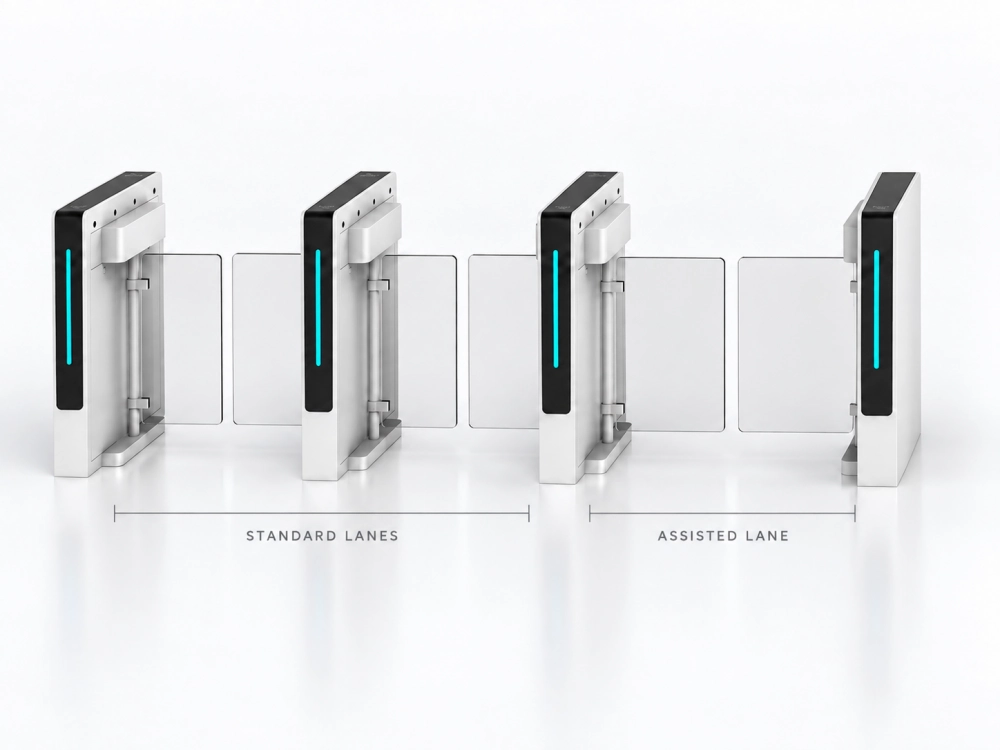
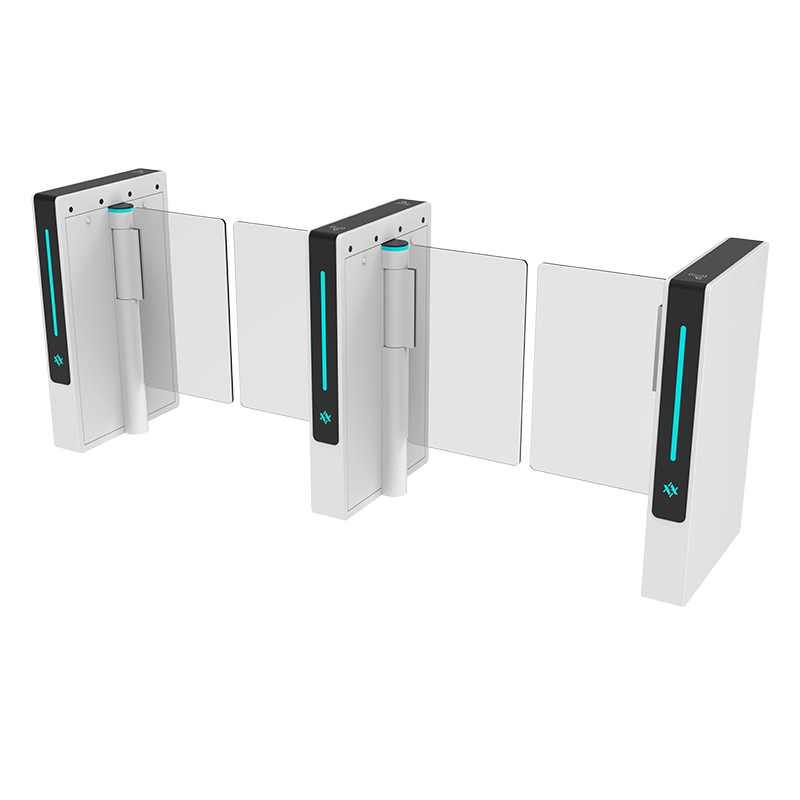
Not every airport lane needs the same width. Standard passages can serve independent passengers carrying small cabin bags, while a wider swing-gate lane can accommodate wheelchairs, strollers, airport carts and larger luggage. The wider lane should be part of the original layout rather than an improvised gap added after installation.
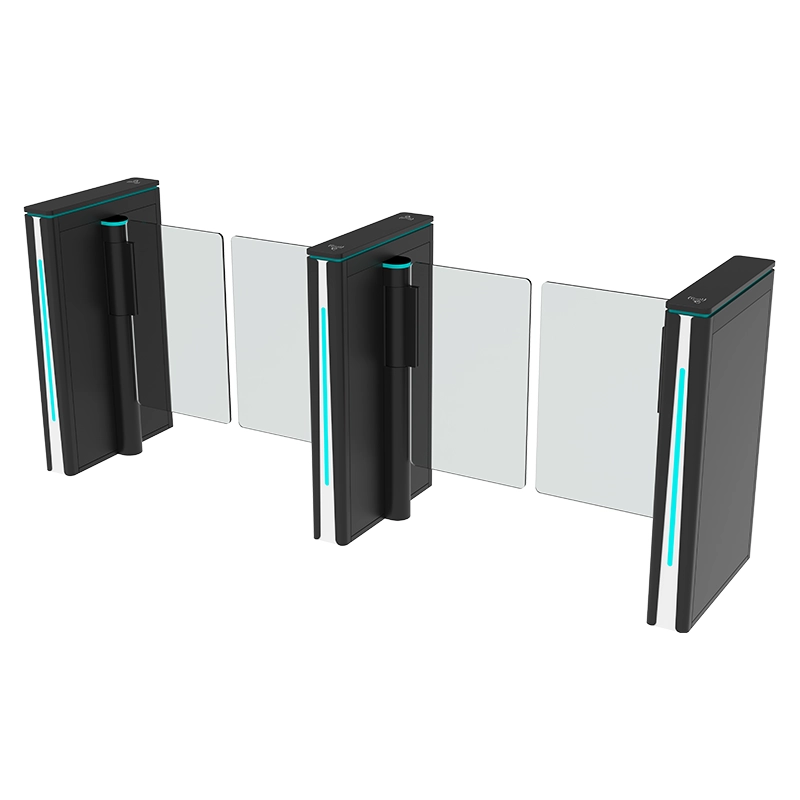
The first image shows the basic relationship: two standard passages and one wider assisted passage formed by four coordinated cabinets. The purpose is not to prescribe a universal number of lanes. It shows how different users can be assigned to the correct route without weakening the overall gate line.
When evaluating lane width, distinguish between the distance between cabinet bodies and the actual clear opening available when the panels move. Cabinet projections, panel geometry, hinges, skirting, adjacent walls and protective rails can all affect usable clearance. Local accessibility requirements and the surrounding accessible route must also be reviewed for the specific project. For U.S. projects, the U.S. Access Board guide to accessible routes is a useful reference, but final compliance remains a project responsibility.
AIPADA’s AT206 commercial pedestrian swing turnstile can be considered for controlled commercial-style entrances where quiet movement, access-control integration and selectable passage arrangements are important. The exact cabinet spacing, panel dimensions and project configuration should be confirmed before manufacture.
Plan Airport Swing Gates Around Luggage Movement
Airport luggage changes the shape and timing of passage. A rolling suitcase may trail behind its owner, a traveler may pull two bags at different angles, and a trolley occupies more space and remains in the detection zone longer than a person walking normally. If the lane is tested only with an empty-handed installer, these conditions remain undiscovered until the entrance is busy.
The gate must distinguish normal baggage movement from an unauthorized second person. That task depends on sensor placement, controller logic, passage speed and the sequence in which the person and luggage enter the lane. It is not enough to specify that a model “has infrared sensors.” The project team should understand the detection zones and test the proposed logic with representative objects.
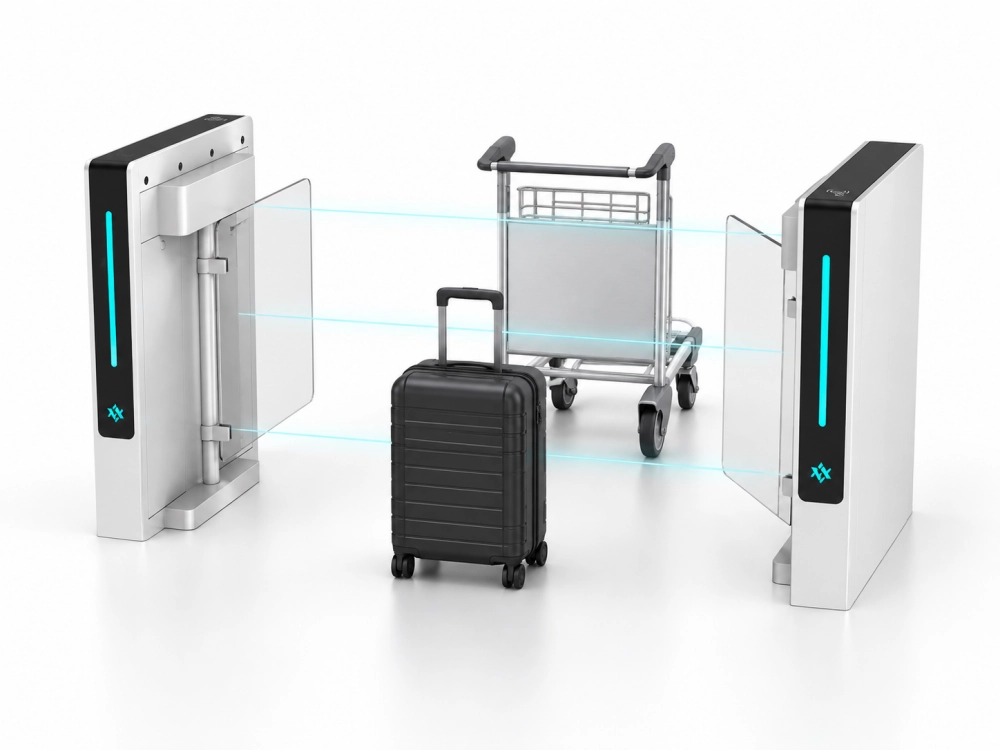
Commissioning tests should include a small cabin bag, a large rolling suitcase, two bags pulled together, a luggage trolley, a stroller and a wheelchair where those movements are expected. Test slow passage, brief stops, a bag crossing after the passenger and an object remaining near the panel path. Record the response for each case instead of relying on a general demonstration.
For a closer explanation of detection order, see the AIPADA guide to the optical swing turnstile sensor sequence.
Match Credentials to the Passenger Journey
Airport swing gates may receive QR codes, printed barcodes, RFID cards, mobile credentials or signals from another passenger-processing system. The gate itself does not decide whether a passenger is eligible to enter. A reader captures the credential, the connected system validates it, and an access controller sends the opening command when the result is approved.
The physical arrangement must support that sequence. A scanner mounted too far forward may encourage passengers to lean across the closed barrier. A reader placed at an awkward angle can slow phone scanning. Strong reflections, screen brightness, damaged paper and unfamiliar user behavior may increase transaction time even when the access-control interface works correctly.
Before production, confirm who supplies the reader, where it will be installed, its dimensions, its power requirement and the signal exchanged with the gate controller. The system integrator should also define what happens when a credential is rejected, expires during use or is presented at the wrong lane.
A failed scan is an operating event, not merely an error message.
The display should give the passenger a clear next action, while the lane remains available or the passenger is directed out safely. Repeated scanning in the middle of a busy lane can reduce effective capacity far more than a small difference in the gate’s mechanical opening time.
Keep Credential Exceptions Outside the Main Queue
Although the revised image no longer shows a separate “exception desk,” the operating plan still needs an exception procedure. A passenger with a failed boarding pass, an unreadable phone or an authorization problem should not remain stationary inside the controlled passage while staff investigate.
A practical arrangement places staff close enough to observe the lanes and assist quickly, but not where a discussion blocks approaching passengers. Depending on the airport process, the passenger may be directed to a nearby staffed position, returned to the uncontrolled side or moved into a designated assistance route.
Define the procedure for at least four outcomes:
- Successful validation: the selected lane opens and records the passage.
- Unreadable credential: the passenger receives a clear retry or assistance instruction.
- Invalid authorization: the barrier remains controlled and staff manage the passenger outside the lane.
- Safety interruption: the gate responds according to the agreed emergency and obstruction logic.
This separation protects throughput without implying that every airport requires a permanent counter beside the turnstiles. The physical solution may be a staffed podium, a nearby service point or a mobile employee position, depending on the terminal workflow.
Use Peak Scenarios Instead of a Single Capacity Number
A published throughput figure describes performance under defined conditions; it does not automatically predict airport queue length. Effective capacity is reduced by hesitant users, poor reader placement, luggage, accessibility needs, rejected credentials and passengers who enter the wrong lane.
A more useful review models several short operating scenarios:
| Scenario | What changes | What to observe |
|---|---|---|
| Normal flow | Mostly valid credentials and small bags | Average passage time and lane balance |
| Departure wave | Many passengers arrive within minutes | Queue growth and recovery time |
| High luggage load | More trolleys and trailing suitcases | Sensor response and assisted-lane demand |
| Credential disruption | Reader or network response becomes slower | Exception handling and queue diversion |
Run the analysis for each direction of travel. Some gates may operate one way during a departure period and reverse later, while others require controlled bidirectional operation. Staff sightlines, signs and passenger approach space must still make the active direction obvious.
Commission Safety and Sensor Logic on Site
Factory testing cannot reproduce every terminal condition. Final commissioning should be completed with the installed readers, actual lane spacing, finished floor, surrounding barriers and expected passenger objects. The project team should agree in advance who can adjust controller parameters and who accepts the final behavior.
Verify opening, closing and alarm responses when a person walks slowly, stops, reverses direction or follows another person. Test luggage at the edge and center of the lane. Check the behavior after power interruption and when the emergency input is activated. Confirm how the transparent panels move when the lane is occupied and how staff release the passage when assistance is required.
Security and safety are related but different. More aggressive closing does not automatically produce a better airport entrance. The operating logic must balance controlled one-person passage with the predictable movement of children, older travelers, wheelchair users and passengers managing luggage.
Prepare an Airport Swing Gate Procurement Brief
A useful request for quotation should describe the project rather than list only a product name and quantity. Send the supplier a plan showing the gate line, approach direction, available depth, required clear passages, nearby walls and the preferred reader locations.
Include the following information:
- Number of standard and assisted lanes
- Required clear width for every lane
- Expected peak passenger flow in each direction
- Typical luggage, trolley and accessibility requirements
- Credential and reader types
- Access-controller interface and responsibility boundaries
- Normal, rejected and emergency operating sequences
- Power, cabling and network provisions
- Floor condition and fixing method
- Finish, branding and architectural requirements
- Commissioning tests and documentation required
If a wider passage is central to the project, review the pedestrian swing gate planning guide for accessible entrances. You can also compare available models in the AIPADA swing turnstile range.
Questions to Resolve Before Final Approval
Should every airport swing gate lane be wide?
Not necessarily. A mixed layout can use standard lanes for normal traffic and a wider assisted lane for wheelchairs, strollers, trolleys and larger baggage. The final arrangement should follow measured demand and local accessibility requirements.
Can a suitcase trigger a false tailgating alarm?
That depends on sensor coverage and controller logic. Representative baggage must be tested during commissioning so the system can handle normal trailing luggage without ignoring a second person.
Can airport swing gates work with boarding-pass or QR readers?
Yes, when the selected reader, validation system and controller provide compatible interfaces. Confirm the hardware dimensions, signal type, response time and failure procedure before production.
Is the fastest opening speed always best?
No. Reader response, passenger hesitation, luggage movement, detection logic and safe panel operation all affect real throughput. The complete passenger journey matters more than one mechanical speed value.
Plan the Passenger Journey Before Selecting the Gate
The best airport swing gate layout is not simply the one with the largest number of cabinets. It is the arrangement that keeps valid passengers moving, gives assisted users a practical route, detects baggage reliably and removes unresolved credentials from the main flow without confusion.
AIPADA can review your entrance drawing, lane-width requirements, expected peak traffic, luggage conditions, reader dimensions and controller interface. Send the project layout and passenger-flow requirements to request a suitable swing-gate configuration and quotation.
](https://aipadaturnstile.com/wp-content/uploads/2025/12/popup-img.jpg)