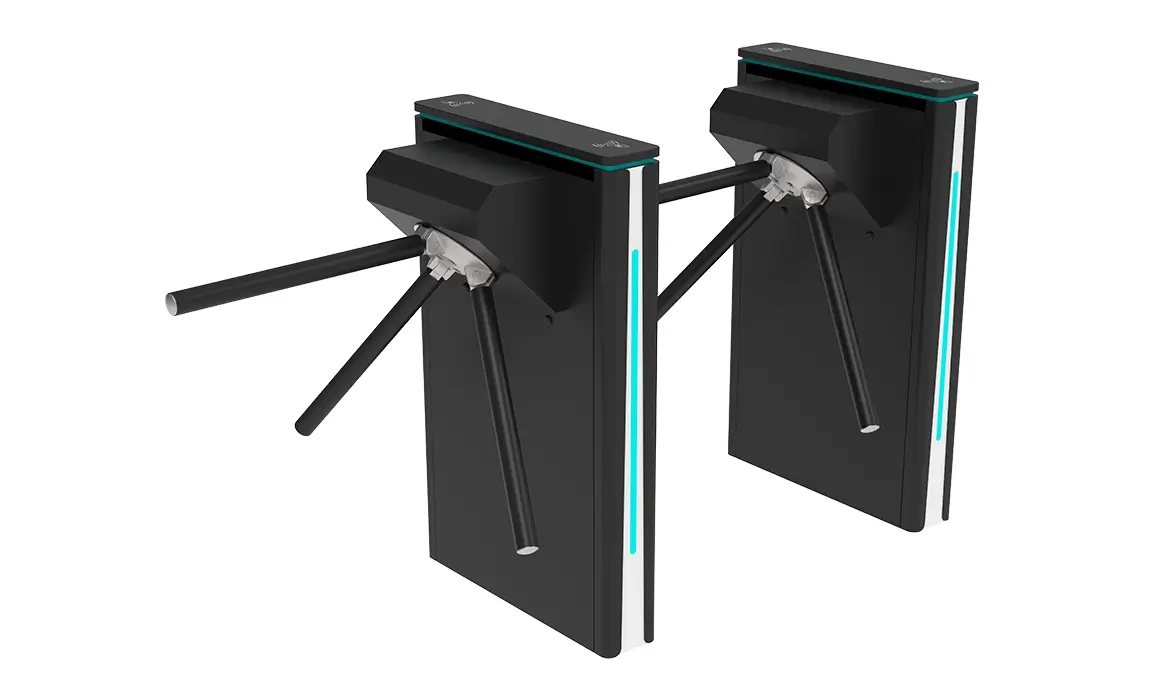

A tripod turnstile is the workhorse of pedestrian access control: simple, cheap to run, and still working long after flashier gates have gone back for repair. This guide covers the engineering, the selection criteria, and the true cost of ownership.
What Is a Tripod Turnstile?
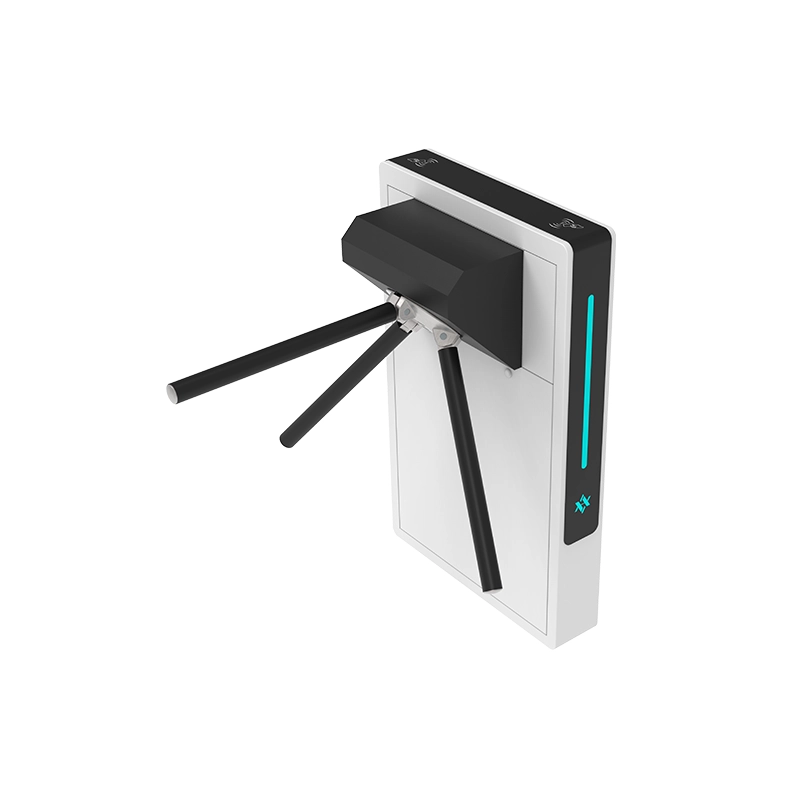
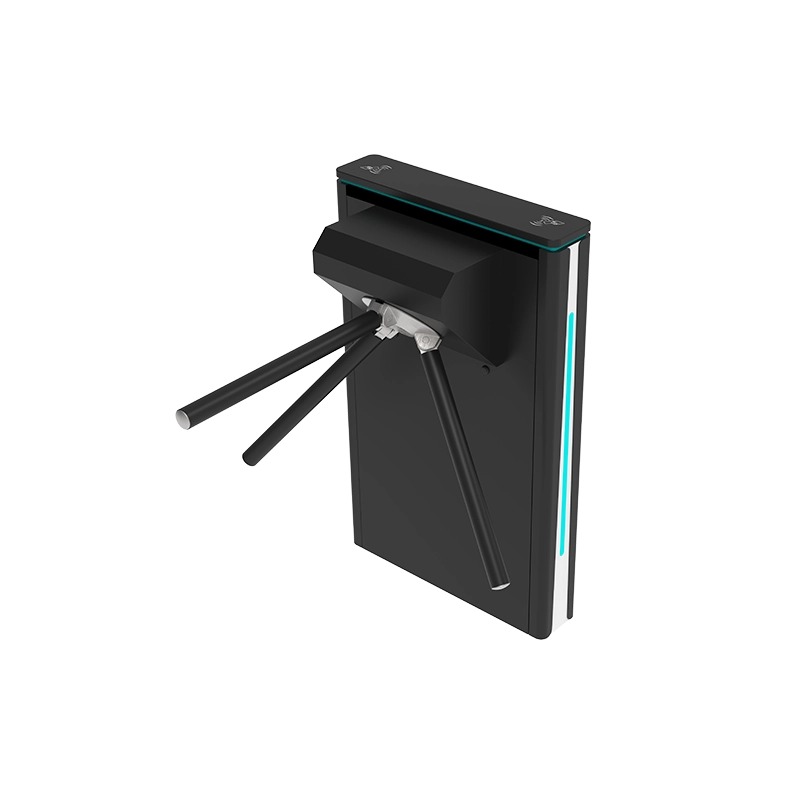
A tripod turnstile is a waist-height access control gate built around a rotating hub with three arms spaced 120° apart. The user presents a credential — card, fingerprint, face, QR code, or token — the mechanism releases the hub for exactly one-third of a turn, the person walks through, and the arms return home and lock.
Because the barrier sits roughly 90–100 cm above the floor, this category is also called a waist height turnstile. That height is the defining trade-off: it makes casual climbing over visibly awkward in a supervised lobby, but it is not a containment barrier the way a full-height cage is.
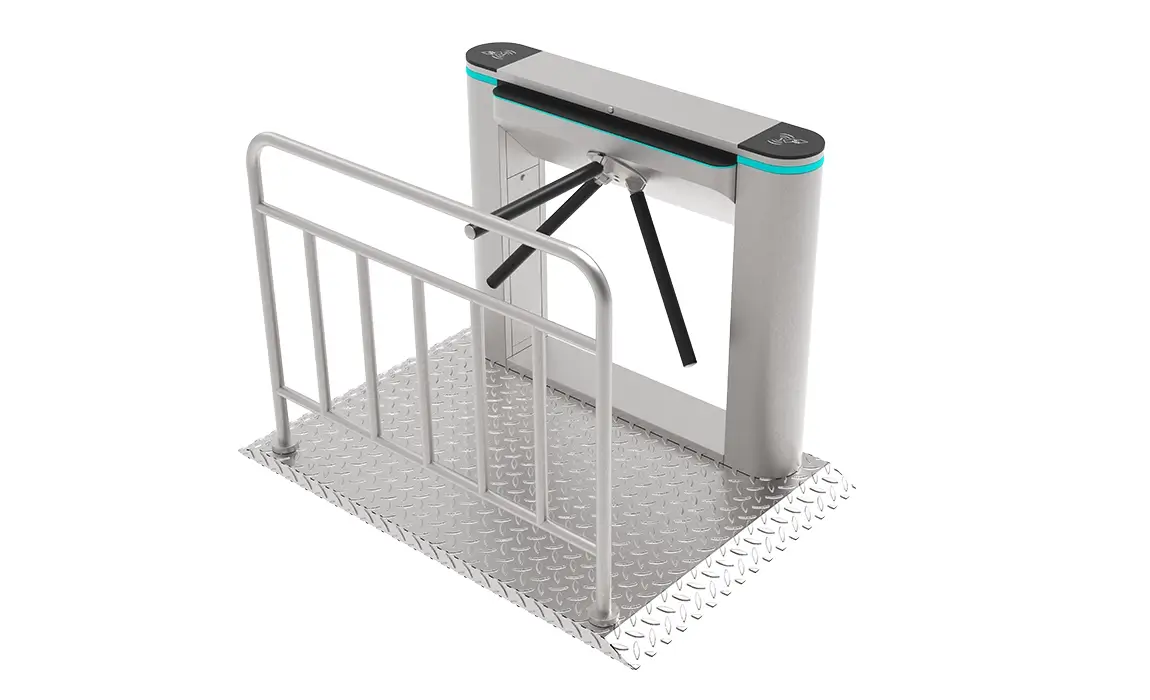
The Core Components
- Rotating hub and arm set — three tubular 304 or 201 stainless arms on sealed bearings.
- Locking disc — a hardened cam plate with three notches at 120° intervals. This is what stops rotation.
- Solenoid or electromagnetic clutch — the actuator that engages and disengages the lock.
- Return spring or damping cylinder — restores the arms smoothly and prevents free-spin.
- Control board — credential input, direction logic, relays, alarms, fire panel interface.
- Infrared sensor array — beam pairs across the lane detecting passage and tailgating.
- Drop-arm latch — releases the leading arm to vertical in an emergency.
That simplicity is why a well-built gate is often rated for 5 million or more full rotation cycles, and why operators in dusty or semi-outdoor environments keep specifying them.
What Waist-Height Means in Practice
A single cabinet occupies roughly 420 × 330 mm, with about 1,200 mm of clear lane for a standard 600 mm arm set. Installation is four anchor bolts, one power feed, one data cable.
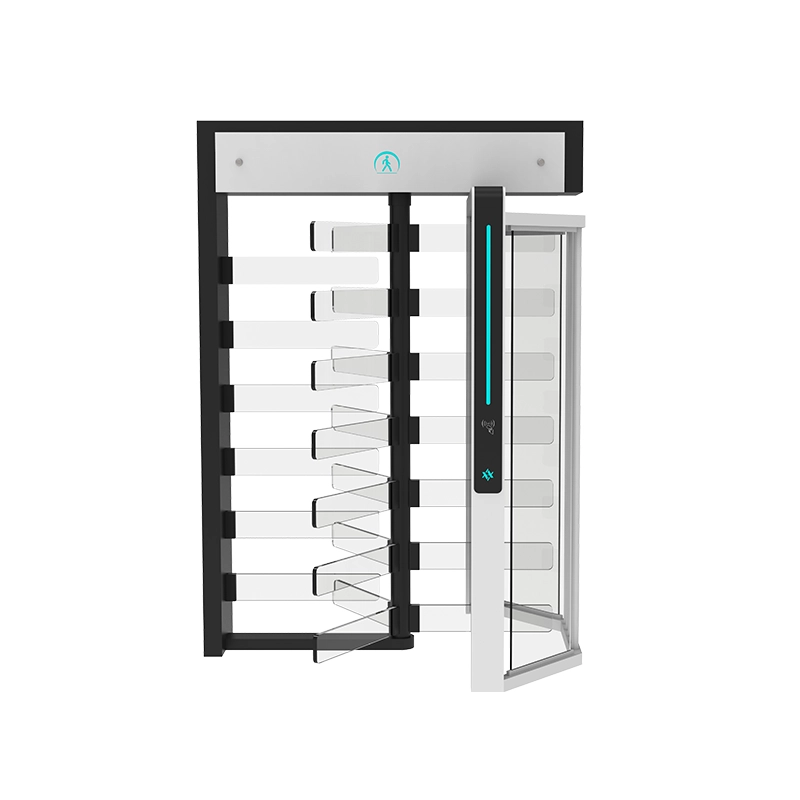
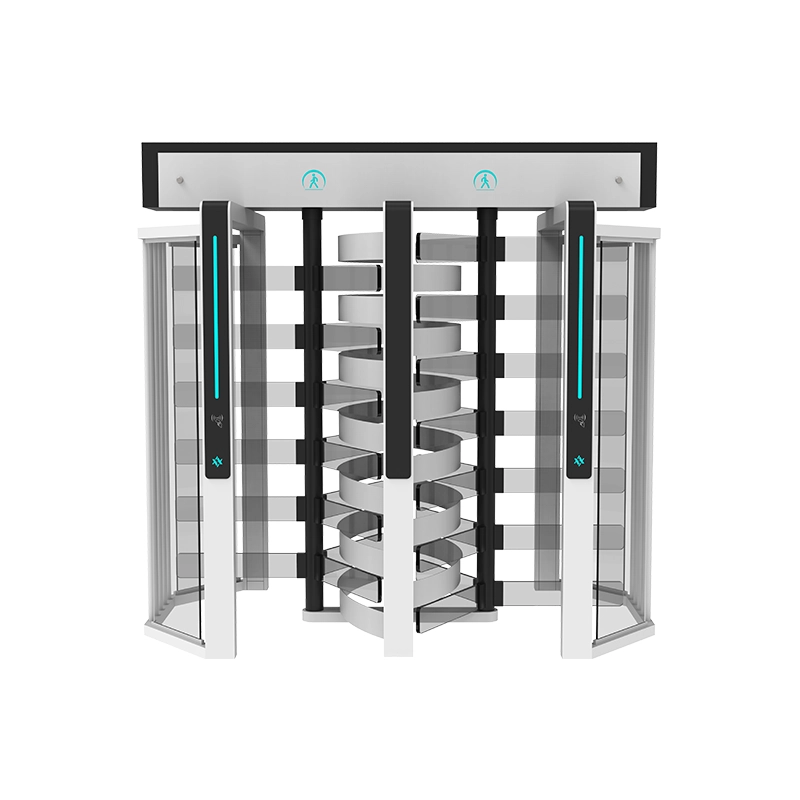
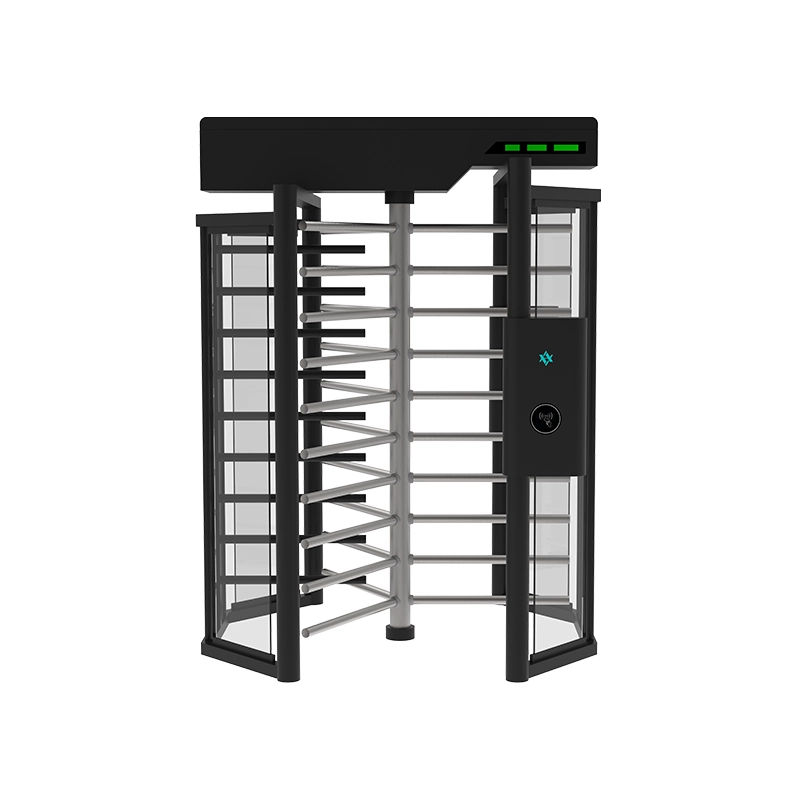
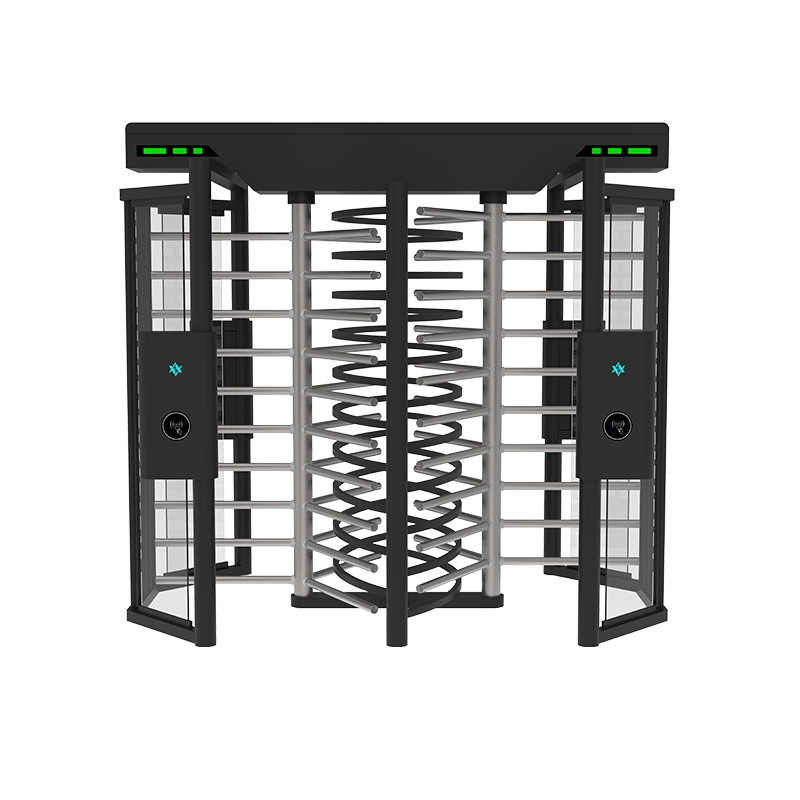
A waist-height gate manages and deters; it does not contain. Where you must stop a determined intruder from climbing over, step up to a full-height turnstile with a floor-to-canopy cage.
How the Unlocking Mechanism Works
Mechanical and Electromechanical Unlocking
In the classic design, a spring-loaded solenoid pin engages a notch cut into the locking disc. Power off means the pin is extended and the disc cannot rotate. On a valid credential the board energizes the solenoid for a short pulse, the pin retracts, and the hub is free. The user pushes the arm through 120°, the pin rides on the disc surface, and when the notch returns the spring pushes it back in.
Two details separate good implementation from cheap. Pulse timing: too short and the user gets locked out mid-passage; too long and a second person slips through on the same authorization. Good boards use sensor feedback instead of a fixed timer. Damping: a properly damped hub stops dead at the detent. An undamped hub slams, and that impact wears out the disc and bearings.
Motorized (Fully Automatic) Unlocking
When evaluating a motorized tripod mechanism with reduction gearing, check the motor-to-output layout as well as the required torque and motion cycle. An inline planetary gearbox selection guide can help explain coaxial transmission layouts. Confirm the actual drive type and mounting interfaces with the turnstile supplier; this background reference does not establish replacement compatibility.
Automatic gates replace the solenoid pin with a geared motor that drives the rotation itself, so the user does not push. Brushless DC motors are the standard for quality units: quiet, no brush wear, and capable of a soft start and stop, which is what makes the arm glide home instead of snapping. Motorized units also re-lift the arm automatically after a drop, so power restoration needs no technician on site.
Bi-Directional Control and Direction Logic
A steering tripod turnstile — the term many buyers use for a unit with a programmable logic board — controls each direction independently. Entry-only during the morning peak, exit-only at end of shift, controlled both ways in a server room, or fully locked in after-hours mode.
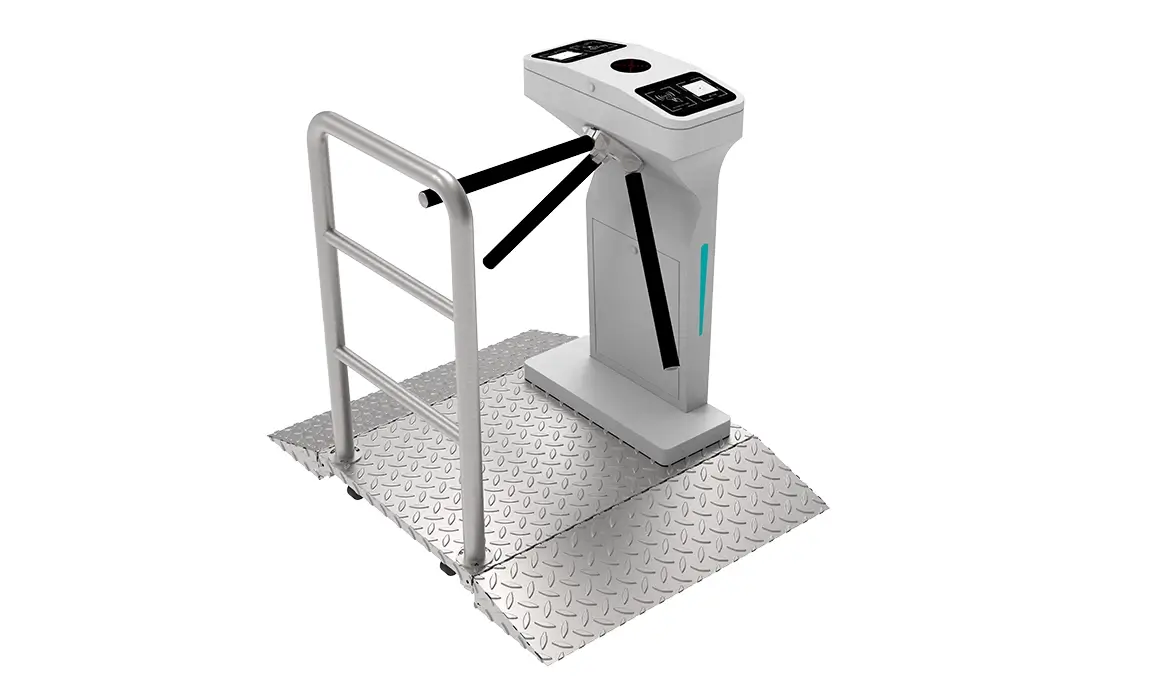
Direction is enforced physically, not just visually. The lock disc has two independently controlled elements, one per direction, so an unlocked entry does not open the exit side. Combined with the sensor array, the board can detect tailgating — a second person crossing the beam before the hub returns home — and lock the arms and alarm, or log the event with a timestamp and camera snapshot.
Fail-Safe Egress: The Drop Arm
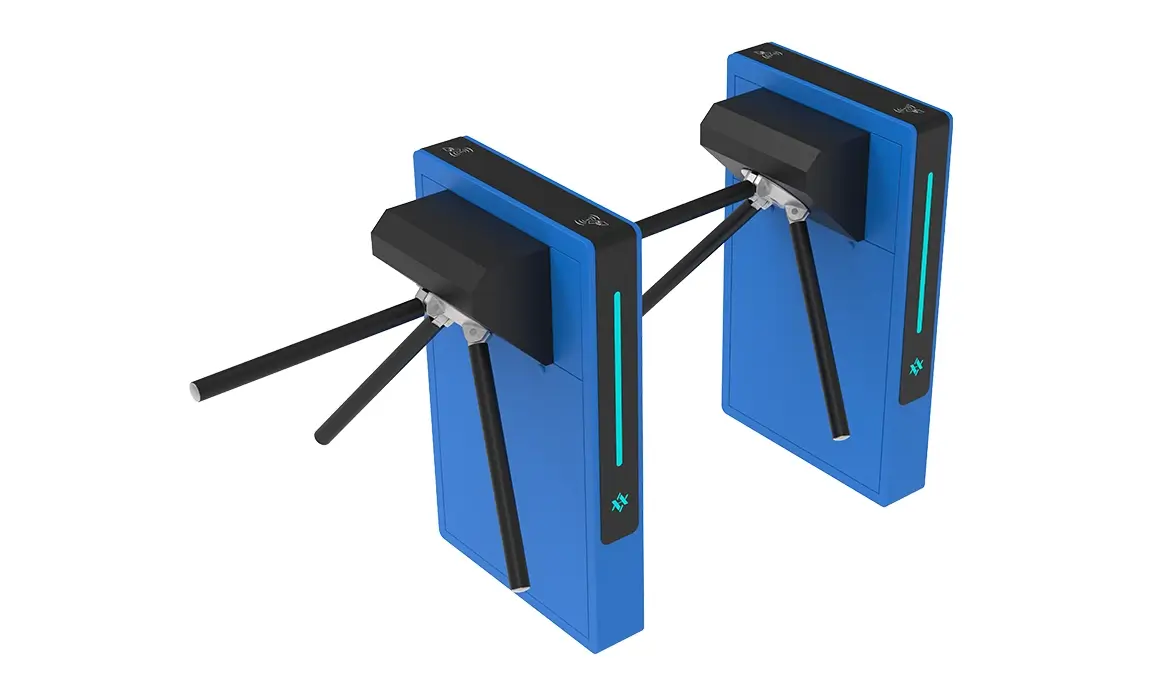
On loss of power, on a fire alarm dry contact from the building panel, or on manual override, the latch releases and the leading arm falls to vertical. The lane is instantly clear.
| System State | Arm Position | Lane Behavior | Reset Action |
|---|---|---|---|
| Normal power, no credential | Horizontal, locked | Blocked | None |
| Valid credential presented | Released for one 120° cycle | Single person passes | Automatic, on hub return |
| Mains power failure | Dropped to vertical | Open, free egress | Automatic re-lift (motorized) or manual lift (semi-auto) |
| Fire alarm signal | Dropped to vertical | Open, free egress | Manual or remote reset after alarm clears |
| Forced entry attempt | Locked, alarm raised | Blocked, event logged | Alarm clears, lane resumes |
Two specification points deserve attention. Confirm the unit is fail-safe rather than fail-locked for any lane in a means of egress — a lane in an exit path that dead-bolts on power loss is a serious code problem. And check the reset method: automatic re-lift after power restoration is what you want, or someone must lift arms at every lane before the entrance can be secured again.
For how this fits the wider family of gate mechanisms, see our guide to turnstile working principles and types.
Semi-Automatic vs Automatic Tripod Turnstiles
This is the first real specification decision and it drives much of the price difference.
Semi-Automatic
The user pushes the arm after the credential is accepted. The mechanism is a solenoid release plus a spring return, with no drive motor.
- Lowest purchase price in the category.
- Very few wear parts — only the solenoid and locking disc cycle.
- Uses the user’s own force, so standby draw is only a few watts.
Downsides: users must know to push, which needs signage and a week of “it isn’t opening” complaints. It is slower — realistically 25–30 people per minute per lane versus 35–40 motorized.
Automatic (Motorized)
- Faster throughput and shorter peak queues.
- Consistent controlled motion with no user-induced slam, so the disc and bearings last longer.
- No push force required, which is better for accessibility.
- Smoother integration with biometrics, where verification completes before the user reaches the gate.
Downsides: higher unit price, an extra failure point in the motor and driver, and slightly higher power draw.
Which One to Specify
Use semi-automatic where traffic is modest and predictable: a small office, a workshop staff door, a site office, a low-volume gym. Use motorized where arrivals concentrate into a short window — a factory shift change, a stadium gate, a school at the bell — or where users carry boxes or use mobility aids.
304 vs 201 Stainless Steel
Almost every tripod turnstile cabinet is stainless steel, and almost every price difference traces back to which grade. Both are austenitic with similar strength and appearance when new; the difference is corrosion resistance, driven by nickel and chromium content.
| Property | 201 Stainless | 304 Stainless | 316 Stainless |
|---|---|---|---|
| Corrosion resistance | Basic, indoor dry | Good, indoor and sheltered outdoor | Excellent, coastal and chemical |
| Magnetic behavior | Noticeably magnetic | Weakly magnetic after forming | Weakly magnetic after forming |
| Suitability | Offices, clinics, dry lobbies | Factories, gyms, sheltered entrances | Seaports, food and chemical plants |
| Relative cost | Lower | Mid | Highest |
Practical guidance: 201 is fine for a climate-controlled lobby cleaned with a damp cloth. Step up to 304 for anything exposed to humidity, rain splash, sweat, or industrial dust — outdoor entrances, pools, gyms, factory floors. Step up to 316 within roughly 10 km of a coastline, or where chlorides or aggressive cleaning chemicals are present. A fast field check: a magnet clings noticeably to 201 and only weakly to 304.
Selection Table: Matching the Gate to the Site
Work through this with your site data before requesting quotes. Throughput assumes one lane and a competent credential system; a slow read or a badly placed reader cuts these figures regardless of the gate’s capability.
| Site Condition | Drive Type | Material | Throughput / lane | Duty Cycle | Arm Drop |
|---|---|---|---|---|---|
| Small office, indoor lobby | Semi-automatic | 201 or 304 | 20–25 / min | Intermittent | Fail-safe drop if in egress path |
| Gym membership entry | Semi-auto or automatic | 304 | 25–35 / min | Intermittent, peaks at class times | Fail-safe drop |
| Factory shift change | Automatic | 304, IP54+ | 35–40 / min | Continuous during two daily peaks | Drop + fire panel interface |
| Stadium concourse | Automatic, multiple lanes | 304 | 35–45 / min | Burst duty, high volume | Drop, remote group release |
| Construction site | Semi-automatic, rugged build | 304 with canopy | 20–30 / min | Intermittent, dusty | Fail-safe drop |
| Transit station or BRT | Automatic, bi-directional | 304, high IP rating | 40+ / min | Continuous, extended hours | Drop + group emergency opening |
| Coastal or chemical plant | Automatic | 316 | 30–35 / min | Continuous | Fail-safe drop |
Two items are easy to forget. Lane width: a standard lane is about 600 mm, but sites admitting wheelchairs, cleaning carts, or luggage trolleys need 900 mm. Reader placement: a reader mounted 400 mm too far forward is the most common cause of “the gate doesn’t open” complaints on a system that works perfectly.
Best-Fit Applications
Gyms and Fitness Clubs
Membership entry is a volume business with low tolerance for friction. A tripod turnstile pairs with a QR or RFID reader tied to the membership database: one scan, one person, one entry event, no reception staff needed at the door. Specify 304 here even if the entrance is “indoor” — sweat and humidity are the enemy of 201.
Stadiums and Event Venues
Gates sit idle for days, then move tens of thousands of people in ninety minutes. This is automatic-drive territory, installed in banks of two to eight lanes on a single controller so a supervisor can release the whole bank at once. Tripod units also survive a crowd leaning on them, which glass-panel speed gates do not.
Factories and Industrial Plants
Shift change is the defining pattern: 1,500 to 3,000 people past a gate line in a thirty-minute window, with every entry logged against the right employee. Low maintenance matters because a gate that is down at shift change is a production problem, not a convenience problem.
Construction Sites
Attendance tracking, subcontractor verification, and induction compliance all run through the site gate. Construction environments are dusty and hard on equipment — exactly where a mechanical tripod gate outperforms anything with optics or a belt drive.
Public Transport
Fare gates at stations and BRT platforms combine very high daily cycle counts with near-zero tolerance for downtime. Tripod units are common because they are fast enough for the volume, they tolerate being pushed, and the drop arm gives a clean emergency egress path that can be triggered for a whole gate line at once.
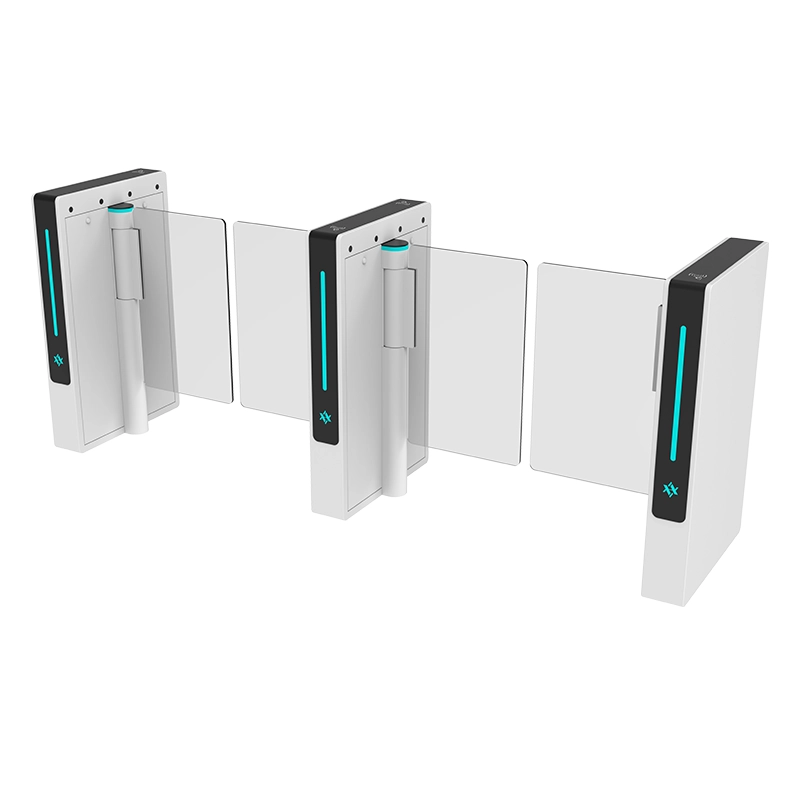
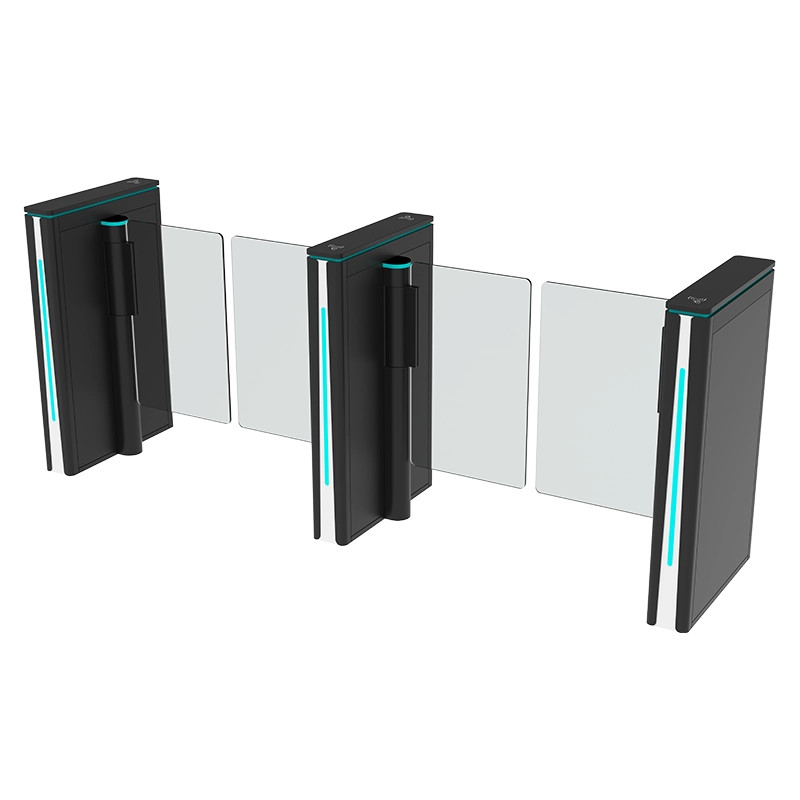
Sites needing a faster, more prestige entrance often mix gate types, using flap barrier turnstiles for the high-throughput main entrance and tripod units at staff and service doors.
Tripod vs Flap Barrier vs Full-Height Turnstile
| Factor | Tripod Turnstile | Flap Barrier / Speed Gate | Full-Height Turnstile |
|---|---|---|---|
| Barrier height | Waist height, ~90–100 cm | Waist height, glass or acrylic wings | Floor to canopy, ~2.2 m |
| Climb-over resistance | Low to moderate | Very low | Very high |
| Throughput per lane | 25–45 / min | 40–60 / min | 20–30 / min |
| Footprint per lane | Compact | Wider, needs clear cabinet space | Large |
| Indoor / outdoor | Both | Mostly indoor | Both, excellent outdoor |
| Accessibility | Wide lane or bypass gate needed | Good with a wide lane | Separate accessible gate required |
| Emergency egress | Fail-safe drop arm | Wings retract on alarm | Cage rotates freely on alarm |
| Relative unit cost | Lowest | Mid to high | High |
| Best fit | Gyms, factories, sites, transit, staff doors | Corporate lobbies, airports, premium retail | Stadiums, power plants, ports |
Choose a tripod turnstile when the goal is to manage flow, log entries, and deter casual misuse at the lowest cost per lane. Choose a flap barrier when throughput and aesthetics lead and the environment is clean and supervised. Choose a full-height turnstile when you must actually stop someone and the site can spare the space.
Tripod Turnstile Price and Total Cost of Ownership
Market Reference Range
As a market reference for China ex-works supply, tripod turnstiles generally fall in the range of USD $150 to $500 per unit. The spread comes from drive type (semi-automatic at the low end, motorized at the high end), steel grade (201 versus 304, with 316 higher again), and electronics (a basic relay board versus a full controller with bi-directional logic, anti-tailgating, fire interface, and event logging).
Two cautions. This is a market reference band for the mechanism and cabinet — it is not a quotation and not a published AIPADA price list. And the gate is rarely the biggest line on the project: readers, controllers, civils, and installation regularly exceed the hardware cost.
What Moves the Price
- Drive type: the single largest delta between entry-level and premium units.
- Steel grade and gauge: 304 over 201, and a heavy cabinet over a thin one — this is where cheap units quietly save money.
- Controller capability: direction logic, anti-tailgating, event memory, network interface, dry-contact integration with fire and BMS.
- Mechanical rating: a mechanism rated for 5 million cycles costs more than one rated for 1 million, and is cheaper per year of service.
| Cost Element | What to Expect | How to Control It |
|---|---|---|
| Unit purchase | Market reference USD $150–500 per unit depending on spec | Match drive type to real throughput; do not over-spec |
| Readers and controllers | Often comparable to or greater than the gate cost | Standardize on one credential platform across all lanes |
| Installation and civils | Anchoring, conduit, power, network drop per lane | Finalize lane layout before pouring or tiling |
| Power | Low, tens of watts per lane at 24 V DC typical | Centralize the supply for the gate line |
| Preventive maintenance | Sensor cleaning, solenoid and latch check, anchor torque, bearing inspection | A scheduled annual service prevents most emergency calls |
| Consumable parts | Solenoid, arm set, sensor board, return spring over the machine’s life | Buy from a supplier who stocks spares and publishes part numbers |
| Downtime | The largest hidden cost — a blocked shift change, a stalled queue | Specify the higher cycle rating; keep a spare arm set on site |
When you request quotations, ask for the cycle rating, the steel grade, the IP rating, the spare parts list, and the warranty terms — a supplier who answers all five quickly has built the unit many times.
Maintenance and Common Failure Modes
Solenoid Wear
The solenoid is the highest-cycle component in a semi-automatic unit. Every authorized entry is one actuation, and a busy factory gate can see 4,000 to 6,000 per day. Symptoms: the arm becomes intermittent, the pull-in sound changes from a crisp click to a dull thud, or the unit works warm and fails cold.
Fixes: check coil resistance against the datasheet, inspect the plunger for scoring, and verify the controller’s pulse duration is long enough for full release before the user pushes. A solenoid pulsed too briefly fails prematurely even though the part itself is fine. On motorized units the equivalent wear points are the motor driver and gearbox.
Arm Misalignment
The arms must sit precisely at the detent at rest. Misalignment shows up as an arm hanging slightly low, a hub that binds at one point in its rotation, or a failure to lock in one direction. Causes: a bent arm from impact, a worn locking disc, a stretched return spring, or a hub that has shifted on its shaft.
Fixes: check arm straightness with a straightedge, hand-rotate the hub slowly through a full turn to feel the detent engagement, and replace the return spring on schedule rather than on failure. On drop-arm units, a drop arm that does not seat cleanly at horizontal will never lock reliably.
Sensors, Connectors, and Environmental Faults
Infrared faults are usually blamed on the board but caused by dirt, condensation, or a mis-set threshold. Clean the lenses, check alignment across the lane, and set sensitivity under the actual lighting conditions. Water ingress is the second most common cause of board failure: verify the cable gland and cabinet seal annually.
| Interval | Task |
|---|---|
| Monthly | Clean sensor lenses and cabinet; test the emergency drop release; confirm the lane opens freely with the arm down |
| Quarterly | Hand-rotate the hub a full turn and listen for binding; check arm straightness and detent alignment; inspect anchors for movement |
| Annually | Measure solenoid coil resistance; inspect the locking disc for wear; replace the return spring on high-cycle lanes; check glands and seals; test the fire alarm interface and backup power behavior |
| Every 3–5 years, high-cycle lanes | Overhaul the mechanism — disc, bearings, solenoid and, on motorized units, the gearbox. Replace worn parts rather than waiting for failure. |
How to Choose a Tripod Turnstile Supplier
Most tripod turnstiles come from the same industrial region of southern China. The difference between suppliers is whether they control their own manufacturing, can prove compliance, and still answer the phone in two years.
- Do they manufacture, or resell? A factory can change a spec, adjust a mechanism, and produce a spare part for a five-year-old model. A trading company usually cannot.
- What certifications can they show? Not “we can get it certified” — show the certificate.
- What is the cycle rating, and who tested it?
- What is the warranty, what does it exclude, and what is the minimum order?
- Can they supply a spare parts list with part numbers?
Where AIPADA Fits
Shenzhen Aipada Technology Co., Ltd., trading as AIPADA, has manufactured turnstiles since 2014. The factory is at Building 19, Guorun Industrial Park, Tangxia Town, Dongguan — a 3,000 m² plant with 80 staff and monthly capacity of 3,000 units. Manufacturing is in-house, which is what makes customization requests practical rather than aspirational.
On compliance, AIPADA units hold CE certification (certificate no. ZR0119400918C) and a CMA and CNAS accredited test report (UCT1648D35). The company also holds a design patent (ZL 2021 3 0788509.8) and four software copyrights covering its controller firmware.
Commercially, terms suit buyers who want to test before committing: MOQ of one unit, lead time of 7–15 days, T/T with a 30% deposit, a two-year warranty, and lifetime technical support. Roughly 40% of exports go to Europe, 25% to the Middle East, 20% to Southeast Asia, and 15% to South America.
The range is here: tripod turnstile models and specifications. Readers and controllers that pair with the gates are listed under turnstile access control hardware. For a quote, contact info@aipadaturnstile.com or WhatsApp +86 191 2995 1956 with the lane count, site environment, expected daily traffic, and credential type.
Frequently Asked Questions
What is the difference between a tripod turnstile and a waist height turnstile?
Nothing structural — they are two names for the same category. “Tripod turnstile” describes the mechanism: a hub with three rotating arms. “Waist height turnstile” describes the barrier height, roughly 90–100 cm, as opposed to a full-height turnstile that extends floor to canopy. Some suppliers use “waist height” to include swing and flap gates at similar height, so confirm the barrier type.
How many people can one tripod turnstile lane handle?
A semi-automatic lane moves roughly 20–30 people per minute; a motorized lane handles about 35–45. The gate is rarely the bottleneck — read speed, reader placement, and lane layout usually determine the real figure. For planning, assume the lower end at peak.
Do tripod turnstiles open automatically during a fire or power failure?
Fail-safe units do. The drop arm releases on power loss or on a fire alarm signal from the building panel, and the arm falls to vertical, leaving the lane clear. If the lane is in a means of egress this is a requirement, not an option, so confirm fail-safe operation in writing on the quotation. On motorized units, check whether the arm re-lifts automatically when power returns or must be reset by hand at each lane.
Can a tripod turnstile be installed outdoors?
Yes, with the right specification. Use 304 stainless, or 316 within about 10 km of a coastline, and choose sealed sensors with a higher ingress protection rating. A canopy over the lane substantially extends service life by keeping standing water off the cabinet and reader. Indoor-rated units installed in the open will corrode at the seams within a couple of years.
Can a tripod turnstile be integrated with facial recognition or a fare system?
Yes. Nearly all commercial tripod turnstiles accept a standard dry-contact or relay input, and many support Wiegand 26 or 34, which is what most card and biometric readers use. Facial recognition terminals, RFID readers, QR scanners, and ticket validators can all drive the gate. Confirm the controller’s interface list before you buy.
What is the typical lead time and minimum order?
Many Chinese manufacturers, including AIPADA, work from a minimum order of one unit with a lead time of 7–15 days and standard terms of T/T with a 30% deposit. Larger orders, custom lane layouts, and unusual steel grades extend the lead time, and shipping transit sits on top of production time. Ask for production and shipping time as two separate figures.
Bottom Line
A tripod turnstile is not the most advanced access gate you can buy, and that is precisely its value: mechanically simple, cheap to run, fast enough for most sites, and — with a fail-safe drop arm — code-compliant in an emergency. Get three specifications right (drive type, steel grade, lane count) and the gate will do its job for a decade.