
If you are comparing entrance hardware for a factory gate, an office lobby, or a stadium concourse, the waist height turnstile is usually the first product a supplier quotes — and the one most often specified by catalog photo rather than numbers. That is how projects end up with a gate that queues at 8:05 a.m. or that fails an accessibility audit. This guide covers what a waist height turnstile actually is, the three mechanisms sold under that name, real throughput and security numbers, current price bands, and the material and installation decisions to lock before you sign a purchase order.
The short version: waist height turnstiles are compact, low-cost, supervised barriers that manage flow well and contain intrusion poorly.
What Counts as a Waist Height Turnstile
A waist height turnstile is a pedestrian barrier whose moving element sits at roughly the height of an adult’s waist. In practice that means a barrier — rotating arms, retracting flaps, or a swinging wing — whose blocking surface tops out between 900 mm and 1,100 mm above finished floor level. The pedestal can be taller, up to about 1,200 mm on full-frame models, but the part that physically stops you is waist high.
Why that number? Three ergonomic reasons. Clearance: at 900–1,100 mm the mechanism sits above the natural swing of a walking leg and above the arc of a handbag, so nothing clips shins. Force geometry: the barrier must resist a leaning adult without a heavy steel frame, and waist height gives the mechanism enough leverage against the torso to keep the cabinet compact and the drive small. Supervision: a waist height barrier keeps a security officer’s view of the lane unobstructed, exactly what you want when the security model is “staffed gate plus credential check” rather than containment.
The category is defined by height, not by mechanism — the most common point of confusion in this market, because “waist height turnstile” and “tripod turnstile” are used interchangeably in catalogs and buyer searches. Waist height turnstile (or the spelling variant “waist high turnstile”) names the height class; tripod turnstile, flap barrier, and swing gate name the mechanism. So when a supplier says “waist height turnstile,” ask two follow-up questions: which mechanism, and how wide is the clear lane? Those answers determine throughput, accessibility, price, and whether the product fits your building at all.

The Three Waist Height Turnstile Types
Tripod Turnstile: The Rotating Three-Arm Barrier
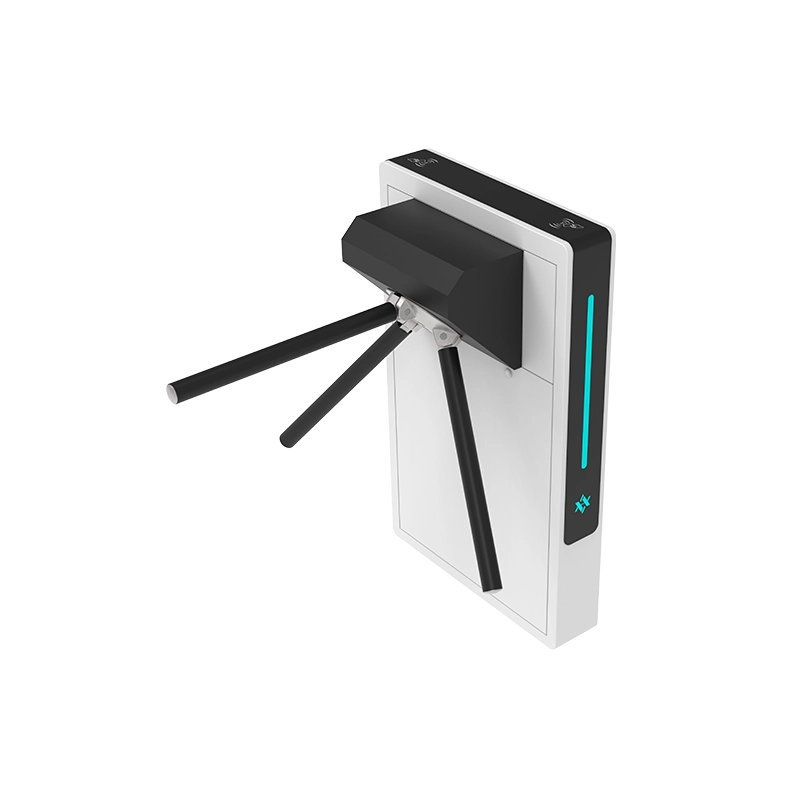
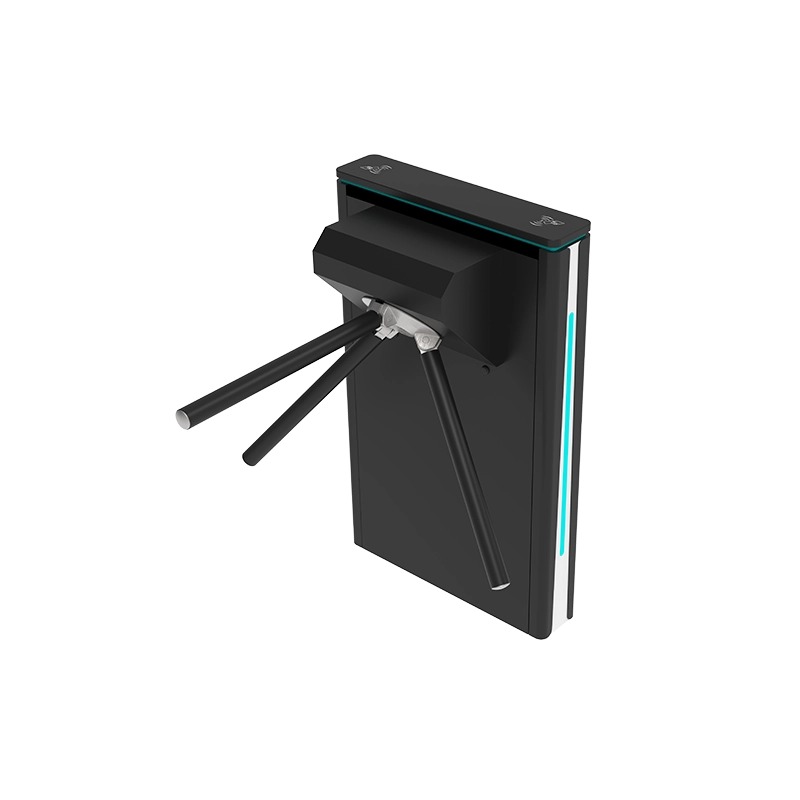
The canonical waist height turnstile. A compact pedestal houses an electromechanical head carrying three arms at 120° apart. On a valid credential, the head releases in the authorized direction and the user pushes the arm through one-third of a rotation, then the head re-locks. Arms sit at roughly 900–1,000 mm and block the lane for one person.
Two drive variants exist and the difference is not cosmetic. A semi-automatic tripod releases the mechanism and lets the pedestrian supply the rotational force — fewer moving parts, no motor to wear out, and the usual choice for factory shift gates and outdoor sites. A fully automatic tripod uses a motor to drive the rotation, giving smoother motion and shorter cycles but adding a drive, an encoder, and a maintenance schedule. Across both: clear lane ~500–600 mm, throughput 20–30 people per minute, and a moderate security level that blocks casual tailgating on a supervised lane but is not containment. A tripod lane is never an accessible route.
Price band: roughly USD $150–500 per lane ex-works China for standard 304 stainless — the lowest entry point in the turnstile market, which is why tripod units still account for the largest volume of installed waist height lanes worldwide.
Best use: factory and warehouse staff entrances, school gates, canteens, construction sites, and attendance-control points where headcount is moderate and the budget is real. If your peak is under about 1,500 people per hour across the lane bank and a guard can see the gate, a tripod is usually the correct and most economical answer. Compare the range in the tripod turnstile product line, and for drives and lane planning read the tripod turnstile guide.
Flap Barrier: Retracting Panels and Higher Throughput
A flap barrier pedestal contains two panels, one per side, that retract sideways into the housing. Closed, they meet near the center of the lane at roughly 900–1,000 mm above the floor. On a valid credential the mechanism drives both panels inward and out of the walking path in a fraction of a second; the user walks through; the panels re-extend behind them and lock.
The mechanism is linear rather than rotary, and that geometry drives every downstream advantage. Because the panels slide into the cabinet rather than sweeping through the lane, there is no clearance arc to protect. Because the stroke is short and the moving mass is light, opening times of 0.3–0.6 seconds are routine. Barrier height is ~900–1,000 mm at the panel top edge, clear lane runs 550–600 mm standard or 900 mm wide, and throughput reaches 30–45 people per minute — with 6–9 IR pairs, the tightest single-person envelope of the three types.
Price band: roughly USD $400–1,200 per lane ex-works China. The premium over a tripod buys the servo drive, the sensor array, the glass or acrylic panels, and the higher cycle rating that comes with continuous peak-hour duty.
Best use: office lobbies, corporate reception lines, metro and rail concourses, gyms, banks, and any entrance with a genuine peak surge. See the flap barrier turnstile range for cabinet lengths, panel finishes, and lane configurations.
Swing Gate: The Pivoting Wing for Wide, Accessible Lanes
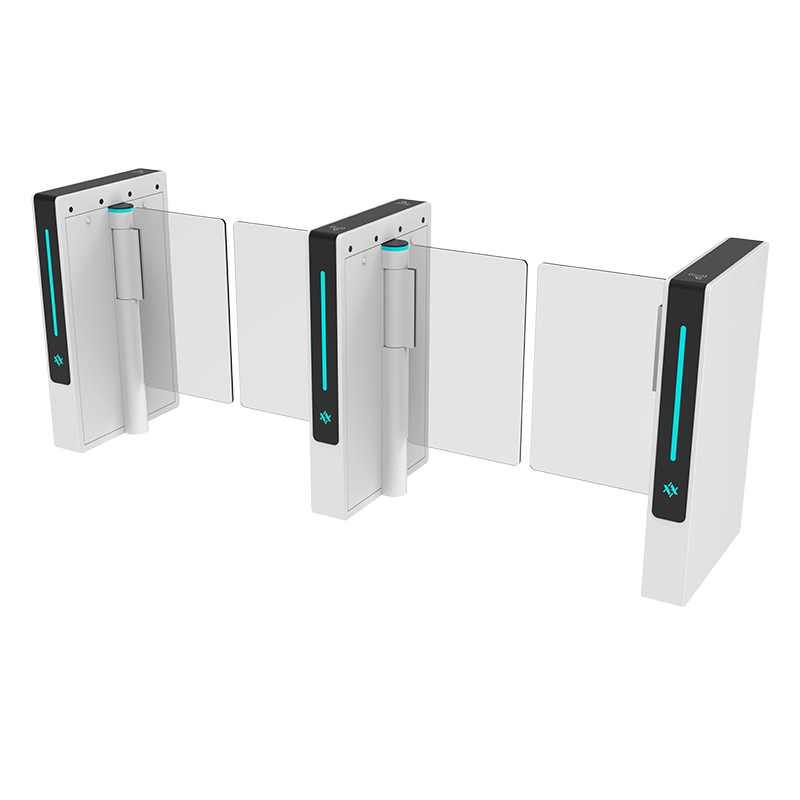
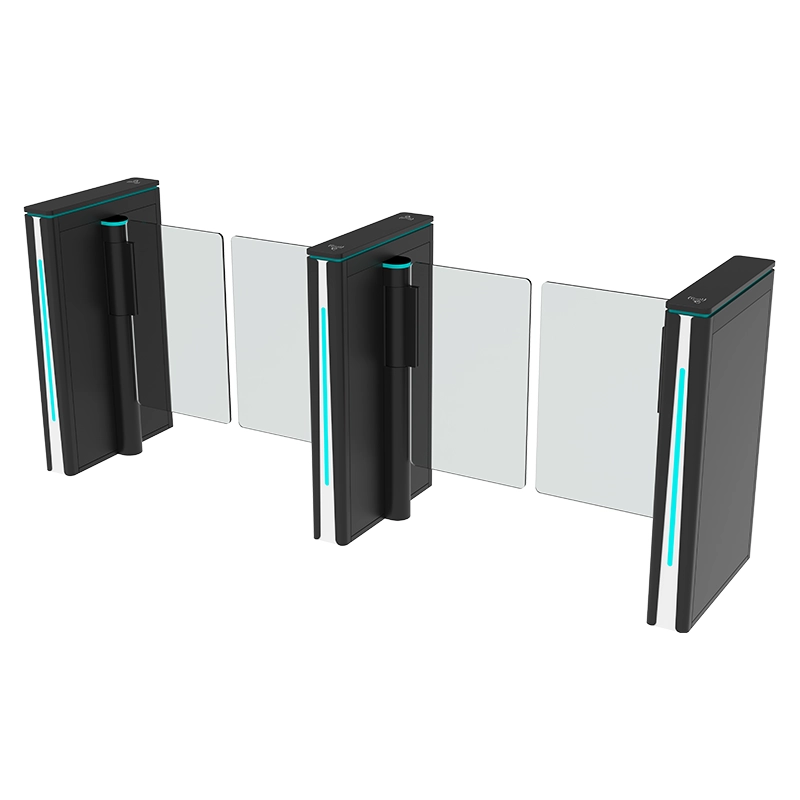
A swing gate replaces the retracting panel or rotating arms with one or two wings mounted on a vertical shaft inside the pedestal. On access granted, the wing rotates outward — typically 90°, with many models able to rotate to 180° or drop into a recess on alarm so the lane becomes a free passage during an evacuation.
Strictly speaking, a full-height glass swing gate sits above the waist height class, so it belongs in the comparison that follows. But waist-height swing variants — lower pedestals with shorter acrylic or stainless wings, and speed gates using the same rotary drive — are the answer whenever accessibility has to be inside the lane rather than beside it. A 900 mm swing lane satisfies an 815–915 mm accessible-route requirement with margin, and throughput of 20–30 people per minute matches a tripod. Security depends on sensor count: a 900 mm lane needs 10–16 IR pairs to match a flap barrier’s tailgating resistance, because the wing opens a wider gap for a follower to hide in.
Price band: roughly USD $500–1,500 per lane ex-works China — typically 15–30% above a comparable flap lane, for a heavier shaft and bearing set, a higher-torque drive, and a larger wing.
Best use: entrances where at least one lane must be accessible without asking staff for help — hospitals, museums, banks, corporate headquarters, and any project subject to a national accessibility code. The real estate cost is genuine: a 900 mm wing needs roughly 900 mm of clear arc plus pedestal depth, kept free of planters, fire cabinets, and queue stanchions.
Waist Height Turnstile vs Full Height vs Speed Gate
| Specification | Waist height turnstile (tripod / flap) | Full height turnstile | Speed gate (glass swing) |
|---|---|---|---|
| Barrier height | 900–1,100 mm | 2,000–2,300 mm enclosure | 900–1,800 mm depending on model |
| Containment | Low — climbable or duckable | High — physical enclosure around the body | Low to moderate |
| Clear lane width | 500–600 mm (tripod/flap), 900 mm (waist swing) | 550–650 mm per rotating section | 550–900 mm |
| Peak throughput per lane | 20–30 (tripod/swing), 30–45 (flap) | 20–30 people/min | 30–45 people/min |
| Emergency egress | Arms drop or panels retract on alarm | Rotating cage can bottleneck; design a release path | Wing releases and swings free |
| Accessibility | Not in the standard lane | Not an accessible route | Yes on 900 mm models |
| Footprint | Small — pedestal plus walking channel | Large — deep circular enclosure | Pedestal plus clear wing arc |
| Indicative price per lane, China ex-works | USD $150–500 (tripod); $400–1,200 (flap) | USD $1,500–4,000+ | USD $500–1,500 (waist height models) |
| Typical application | Factory gates, offices, schools, ticketing | Perimeter and cash-handling areas, unmanned sites | Corporate lobbies, airports, transit |
Read that table as a security-per-dollar curve. Waist height hardware gives you credential-controlled flow at the lowest capital cost, and it works because a human is watching. Full height hardware buys containment and removes the labor cost of watching, at two to eight times the unit price and a much larger footprint.
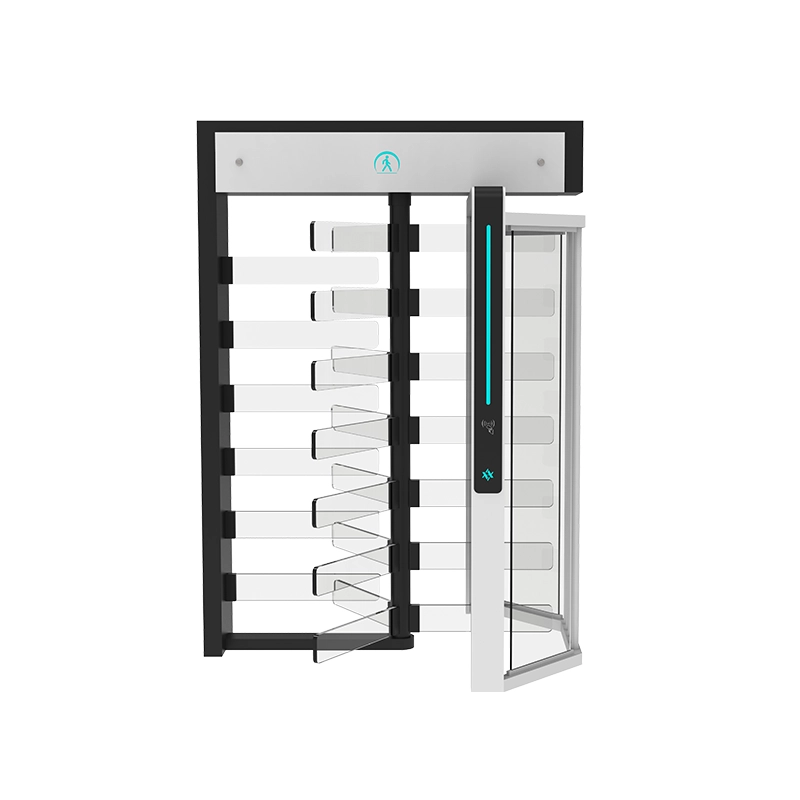
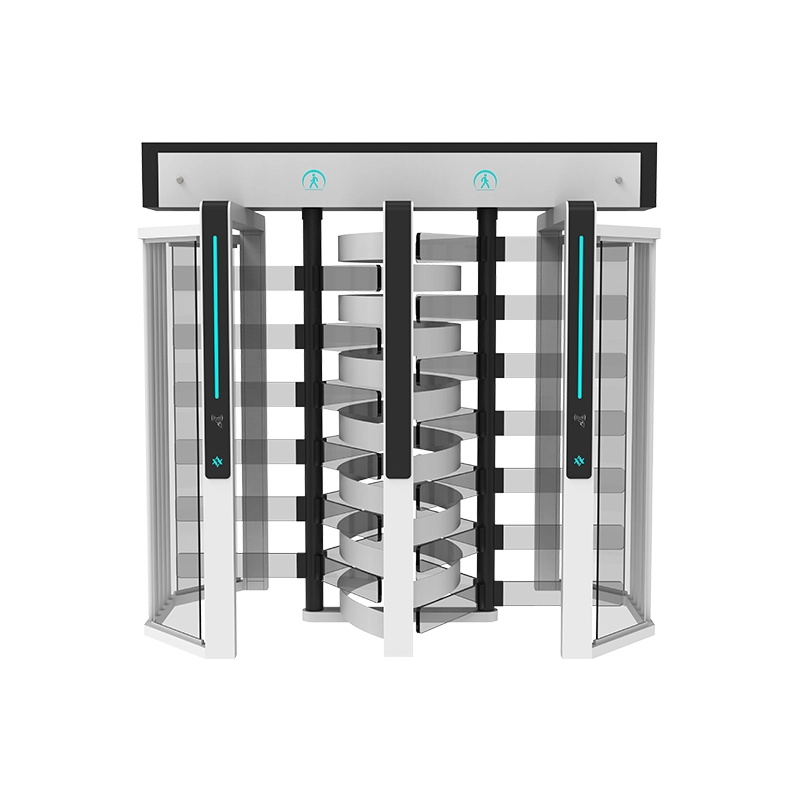
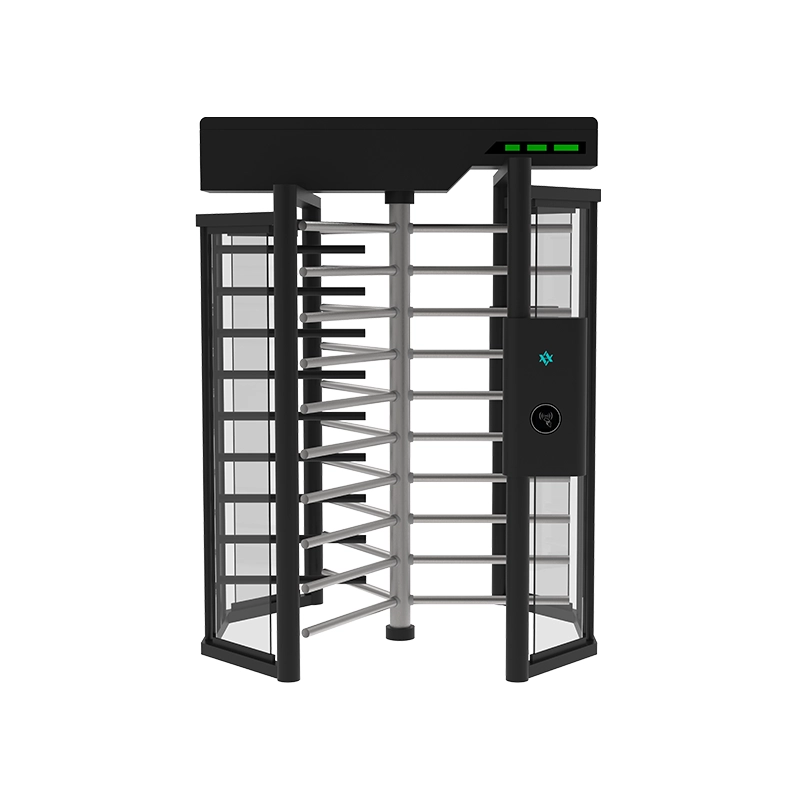
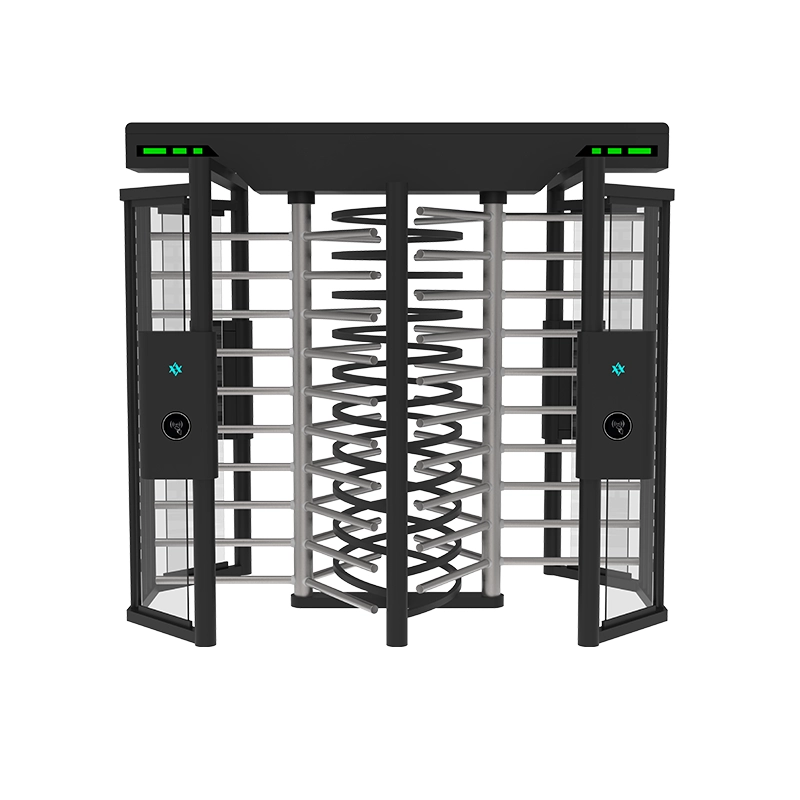
The practical rule: if your threat model includes a determined intruder who will climb, duck, or push through, no waist height product is the right answer — specify full height and stop comparing. Explore the full height turnstile category for those projects. If your requirement is simply keeping unauthorized people out of the staff area during business hours, waist height is sufficient and economical — and the comparison you should be making is tripod versus flap.
Selection Decision Framework
1. Traffic Volume and Peak Loading
Estimate normal and peak arrivals separately — they often differ by a factor of five, and the peak sizes the lane bank. Use realistic capacity, not catalog maxima: 20–30 people per minute per tripod or swing lane, 30–45 per flap lane, assuming trained users. Untrained visitors carrying bags drop those numbers by roughly 40%. A 5,000-person facility with a 45-minute arrival window needs about 1,850 people per hour of lane capacity — two flap lanes with headroom, or three tripod lanes at the edge. Add a redundancy lane; a single gate is a single point of failure on your busiest morning.
2. Security Requirement
Decide honestly what you are protecting against. Credential bypass is what waist height gates handle well, provided you specify anti-passback and enough sensors to detect a second body. Physical intrusion is not something this product class handles. With a security officer at the gate, waist height is appropriate; without one, buy containment instead.
3. Accessibility
If any part of the accessible route passes through the gate bank, at least one lane must be 900 mm clear — a swing gate, or a wide flap model. Do not plan on a staffed side door as the accessible route; it requires asking permission and fails accessibility audits. Where a mixed bank is the answer, our access control integration overview covers running both lane types from one controller and one credential database.
4. Budget
Budget per lane, not per project. Reference bands ex-works China: tripod USD $150–500, flap barrier USD $400–1,200, swing gate USD $500–1,500. Then add what buyers forget: readers, controller and software, plinth and floor works, cabling, power supply, shipping, and duty. On a small project, hardware is often only half the delivered cost.
5. Aesthetics and Building Fit
A gate is the most-touched object in the building. Tripod arms suit industrial and campus gates; flap barriers and waist-height swing gates read as modern and disappear into a reception line.
Materials and Finishes
| Material | Corrosion resistance | Cost index | Where it belongs |
|---|---|---|---|
| 201 stainless | Low — stains and rusts in humid, coastal, or chlorine-exposed air | Lowest | Dry indoor entrances, tight budgets, cosmetic duty only |
| 304 stainless | Good — the industry default for indoor and sheltered installations | Baseline | Office lobbies, factory interior gates, schools, malls |
| 316 stainless | High — resists chloride and salt spray | +20–40% over 304 | Coastal sites, outdoor gates, pools, food plants |
Finishes come on top of the grade. Brushed or satin is standard and hides fingerprints best. Mirror polished photographs well and shows every mark, so it belongs in low-touch lobbies. Powder coating in a custom RAL color matches an interior scheme, but specify it over properly prepared stainless and expect the coating — not the steel — to be the wear surface on high-touch edges. Arm and panel materials follow the same logic: 304 stainless arms for factory gates, acrylic or tempered glass panels for lobby flap barriers, and laminated glass wings where the gate is a design element. For any gate facing rain or coastal humidity, the upcharge for 316 pays for itself before the first warranty claim on a rusted pivot bearing.
Access Control Integration
The turnstile controls the physical lane; the credential system decides who may pass. Keep these as two separate decisions and the project goes smoothly. The gate needs a compatible release input and status output; the reader and controller need to live on a platform your facilities team can administer.
| Credential method | Interface | Best for |
|---|---|---|
| RFID / IC card | Wiegand, RS-485, or TCP/IP to controller | Employee entrances, contractor and student access |
| QR code / barcode ticket | USB or RS-232 scanner to controller or PC | Visitors, exhibitions, attractions, events |
| Fingerprint | Controller release contact | Sites prohibiting shared cards |
| Facial recognition | On-device decision plus relay to gate | Hands-free lanes, high-throughput checkpoints |
| Push button / remote release | Dry contact input | Reception, deliveries, exceptional access |
Anti-passback stops one credential admitting two people or being reused to re-enter. Logic-based tailgating detection compares credentials read against bodies counted in the lane and alarms on a mismatch. Exit-side monitoring keeps the gate from being blind to reverse intrusion.
Waist Height Turnstile Price by Type
Reference pricing below is China ex-works, per lane, standard 304 stainless, in USD. Treat it as a planning band, not a quotation — exact pricing depends on lane count, finish, reader integration, and housing design.
| Type | Reference price per lane (ex-works China) | Main price drivers |
|---|---|---|
| Tripod turnstile (semi-automatic) | USD $150–350 | Cabinet gauge, arm material, finish |
| Tripod turnstile (fully automatic) | USD $250–500 | Motor, encoder, control board, sensor count |
| Flap barrier | USD $400–1,200 | Servo drive, panel material, IR sensor count, cabinet length |
| Swing gate (waist height) | USD $500–1,500 | Shaft and bearing set, wing material, drive torque |
| Reader / biometric terminal (if not customer-supplied) | USD $50–600 per lane | Card only vs fingerprint vs face recognition |
| Controller, software, and commissioning | USD $150–1,500 per project | Lane count, user count, integration depth |
AIPADA (Shenzhen Aipada Technology Co., Ltd., founded 2014) builds all three waist height types in its own 3,000 m² Dongguan plant with 80 staff and capacity of 3,000 units per month. Gates ship with a 2-year warranty plus lifetime technical support, MOQ 1 unit, 7–15 day lead time, and T/T 30% deposit. Tender documentation is available: CE certification (ZR0119400918C), a CMA & CNAS test report (UCT1648D35), design patent ZL 2021 3 0788509.8, and four software copyrights. Exports run Europe 40%, Middle East 25%, Southeast Asia 20%, South America 15%.
Installation Requirements
Waist height turnstiles are bolted-down equipment, not furniture. Confirm six items before production is released.
- Floor and plinth. Gates are anchored with expansion bolts into a level, structurally sound base — typically a concrete plinth or a slab at least 100 mm thick. Confirm finished floor level, because the gate height above the walking surface defines the barrier dimension. Uneven floors need a plinth, not shims.
- Power supply. Confirm voltage, frequency, phase, and whether the bank shares a supply. Include readers, controller, and network equipment in the load.
- Cabling and containment. Plan power, communication, and reader routes with the lane layout, not after it. Concealed conduit must be in before the floor is finished.
- Lane layout and spacing. Verify clear lane width, pedestal spacing, and — for swing and flap units — the clearance arc or panel travel zone in front of and behind the gate. Keep that zone free of signage and queue stanchions.
- Emergency and fire-alarm behavior. Specify in writing whether arms drop, panels retract, or the wing releases freely on power loss or alarm, and whether that happens automatically or via manual release. Confirm the fail-safe direction against your fire code — this is the item that turns a compliant gate into a code violation.
- Environment and drainage. For outdoor or semi-outdoor installs, confirm canopy coverage, wind exposure, standing-water risk, and humidity, then match the steel grade and IP rating accordingly.
Send your entrance drawing, lane count, credential method, peak headcount, and environment in one package. Projects that supply those five items at RFQ stage get a usable proposal in one round instead of three — and our engineering team sizes the mechanism against your numbers before anything is built.
Frequently Asked Questions
Is a waist height turnstile the same as a tripod turnstile?
They usually refer to the same product, but the terms describe different things. “Waist height” is the barrier height class — roughly 900–1,100 mm above the floor. “Tripod” is the three-arm rotating mechanism. A tripod turnstile is a waist height turnstile, but not every waist height turnstile is a tripod: flap barriers and low swing gates share the height class with different mechanisms.
What is the difference between a waist height turnstile and a full height turnstile?
Barrier height and containment. A waist height turnstile blocks from about 900–1,100 mm upward on a short pedestal and is climbable or duckable, so it depends on supervision to be effective. A full height turnstile encloses the user in a rotating cage roughly 2,000–2,300 mm high, which makes casual intrusion impractical and allows the gate to run unmanned — at two to eight times the unit price and a much larger footprint. Choose waist height for supervised credential control; choose full height for perimeter security where nobody is watching.
How much does a waist height turnstile cost?
Reference pricing ex-works China, per lane, standard 304 stainless: tripod USD $150–500 depending on drive type, flap barrier USD $400–1,200, waist-height swing gate USD $500–1,500. Readers, controllers, plinths, cabling, and freight are usually additional, and on small projects those items can equal the hardware cost. Request a quotation against your drawing rather than budgeting from a list price.
Can a waist height turnstile be used outdoors?
Yes, if the model is specified for it. Outdoor installations need 316 stainless rather than 304 to resist humidity and salt, an appropriate IP rating on the drive and control board, canopy coverage where possible, protection from standing water, and a maintenance schedule for sensor windows.
Is a waist height turnstile wheelchair accessible?
The standard lane is not. Tripod arms create an obstruction at roughly 900 mm, and a standard flap lane of 550–600 mm is too narrow for a wheelchair or mobility scooter. The usual solution is a mixed bank: waist height lanes for the main flow plus one dedicated 900 mm swing gate signed as the accessible route.
Which waist height turnstile has the highest throughput?
The flap barrier, by a clear margin. Panel opening runs 0.3–0.6 seconds against 0.6–1.2 seconds for a swing wing and the push-through stroke of a tripod — roughly 30–45 people per minute per flap lane versus 20–30 for tripod and swing lanes. If throughput binds, choose flap barriers and add a swing lane for accessibility. If budget binds, a semi-automatic tripod will handle a supervised gate up to about 1,200 people per hour at a fraction of the cost.
Choosing the Right Waist Height Turnstile
A waist height turnstile is the most cost-effective way to put a credential-controlled barrier at a supervised pedestrian entrance. The mistakes buyers make are almost never about the cabinet: they are about picking a mechanism before settling throughput, assuming a standard lane is accessible, leaving emergency behavior undefined, or failing to confirm that the reader and controller will actually talk to each other. Settle peak headcount, security requirement, accessibility, budget per lane, and aesthetics in that order — and the mechanism follows.
To compare hardware, start with the AIPADA tripod turnstile range, the flap barrier turnstile range for peak-hour throughput, and the full height turnstile range if your project needs containment. For the credential side, the access control integration range covers readers and controllers that run across all three. Still mapping mechanisms? The tripod turnstile guide is the deeper technical companion to this article.